NGC 5315
NGC 5315 is a planetary nebula in the constellation Circinus, magnitude 9.8, 6″ across.
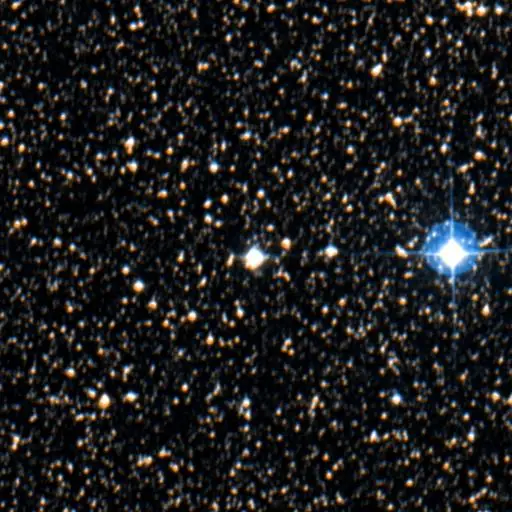
A small planetary nebula around a hydrogen-stripped star blazing at nearly 80,000 kelvin.
At the centre of NGC 5315 is a star that has lost its hydrogen. It is a Wolf-Rayet-type star, class WC4, with a surface at around 76,000–79,000 kelvin, and its light sets the surrounding gas glowing. This planetary nebula is slightly oval, with a complex structure and a broken ring. Its chemistry holds a puzzle: no extra share of the heavy elements such stars usually forge late in life. One explanation is a companion star that cut that phase short. Ralph Copeland discovered it in 1883.
NGC 5315 is 11,000 light-years away: the light we see from it set off around 8980 BC, 530 years after the stone pillars of Göbekli Tepe, the oldest known temple, were raised.
How big is it?
336 Solar Systems side by side. Light itself takes 4 months to cross it. Shrink our Solar System — the Sun and all eight planets — to the size of a coin, and NGC 5315 would be 8.1 m across (about the length of a bus); the nearest star would be a football pitch away, and the Milky Way 2,520 km across.
A 9.8-magnitude planetary nebula in Circinus, about 6″ across. Its central star is magnitude 14.4.
When and where to see it
It is best placed in the evening sky around May, when it crosses the meridian at about 10 pm local time (around midnight in April). It can be seen from everywhere south of 23°N and never sets south of 23°S.
At its highest it stands below the horizon from 50°N, below the horizon from 35°N, 23° up from the equator, 58° up from 35°S.
Facts
- Type
- Planetary nebula
- Constellation
- Circinus
- Designations
- NGC 5315
- Magnitude
- 9.8
- Apparent size
- 6″
- Position
- RA 13h 53.9m, Dec −66° 31′ (J2000)
- Distance
- 11,000 light-years
- Discovered
- Ralph Copeland, 1883
Open AstroPilot to see when NGC 5315 is highest tonight from your location, how easy it is with your telescope or binoculars, and an eyepiece view.