NGC 5253
NGC 5253 is a galaxy in the constellation Centaurus, magnitude 10.3, 5.0′ × 2.1′ across.
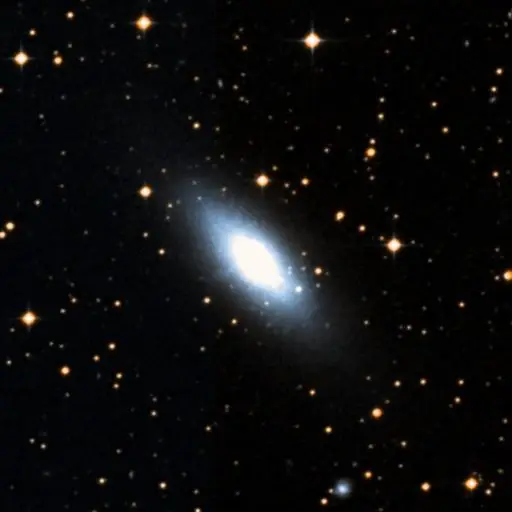
A small galaxy that hosted two of the brightest supernovae of modern times, and hides a cluster of a million stars.
Buried in a giant dust cloud at the heart of NGC 5253 is a newborn cluster of more than a million stars, up to 7,000 of them hot, massive O-type stars. It is only about 3 million years old, yet together its stars outshine a billion Suns. This small, irregular galaxy is a dwarf starburst, making stars at least ten times faster than comparable regions of the Milky Way. It belongs to the group around M 83. William Herschel found it on 15 March 1787.
NGC 5253 is 12 million light-years away: the light we see from it set off about 12 million years ago, when great apes were spreading through Africa and Europe.
Did you know?
- Williamina Fleming’s supernova. In 1895 Williamina Fleming, one of Harvard’s women “computers”, found a supernova here that reached magnitude 8.
- Runner-up of the century. SN 1972E, found by Charles Kowal, peaked at magnitude 8.5. Of all the supernovae seen in the 20th century, only SN 1987A in the Large Magellanic Cloud appeared brighter.
How big is it?
17% of the Milky Way’s width. Light itself takes 17,000 years to cross it. Shrink it to the length of a football pitch and our whole Solar System would be about the size of a red blood cell.
A 10.3-magnitude barred Magellanic spiral galaxy (SBm) in Centaurus, about 5′ × 2.1′.
When and where to see it
It is best placed in the evening sky around May, when it crosses the meridian at about 10 pm local time (around midnight in April). It can be seen from everywhere south of 58°N and never sets south of 58°S.
At its highest it stands 8° up from 50°N, 23° up from 35°N, 58° up from the equator, 87° up from 35°S.
Facts
- Type
- Galaxy
- Constellation
- Centaurus
- Designations
- NGC 5253
- Magnitude
- 10.3
- Apparent size
- 5.0′ × 2.1′
- Position
- RA 13h 39.9m, Dec −31° 38′ (J2000)
- Distance
- 12 million light-years
- Discovered
- William Herschel, 1787
Open AstroPilot to see when NGC 5253 is highest tonight from your location, how easy it is with your telescope or binoculars, and an eyepiece view.