NGC 5248 (C 45)
NGC 5248 (C 45) is a galaxy in the constellation Boötes, magnitude 10.0, 4.1′ × 2.4′ across.
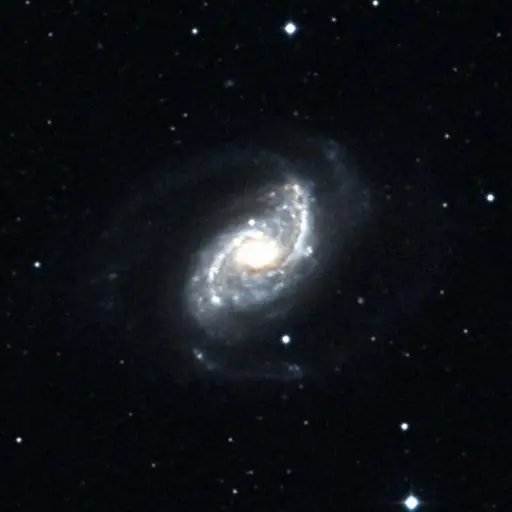
A spiral with only half a bar, in a family of galaxies strung out beside the Virgo Supercluster.
Halfway between barred and unbarred, NGC 5248 is an intermediate spiral galaxy: a compact disc of stars whose central bar is only weakly formed.
It gives its name to a small family of galaxies, the NGC 5248 Group. That group is one of the Virgo III groups, a chain of galaxy groups strung out to the east of the Virgo Supercluster — the vast gathering of galaxies whose outskirts also hold our own Local Group.
William Herschel discovered it on 15 April 1784, one of the many hundreds of galaxies he found in his systematic sweeps of the sky with home-built telescopes.
NGC 5248 (C 45) is 43 million light-years away: the light we see from it set off about 43 million years ago, when mammals were taking over a world without dinosaurs.
Did you know?
- How far away?. The distance to NGC 5248 is debated. Its redshift points to one figure, but 17 independent measurements place it much closer.
- Patrick Moore’s pick. Patrick Moore made it number 45 in his Caldwell catalogue of 1995. He used his own surname, Caldwell-Moore, because the letter M was already taken by Messier.
How big is it?
51% of the Milky Way’s width. Light itself takes 51,000 years to cross it. Shrink it to the length of a football pitch and our whole Solar System would be smaller than a bacterium.
A spiral in Boötes with a bright core and faint, broad arms.
When and where to see it
It is best placed in the evening sky around May, when it crosses the meridian at about 10 pm local time (around midnight in April). It can be seen from everywhere north of 81°S and never sets north of 81°N.
At its highest it stands 49° up from 50°N, 64° up from 35°N, 81° up from the equator, 46° up from 35°S.
Facts
- Type
- Galaxy
- Constellation
- Boötes
- Designations
- C 45
- Magnitude
- 10.0
- Apparent size
- 4.1′ × 2.4′
- Position
- RA 13h 37.5m, Dec +8° 53′ (J2000)
- Distance
- 43 million light-years
- Discovered
- William Herschel, 1784
Open AstroPilot to see when NGC 5248 (C 45) is highest tonight from your location, how easy it is with your telescope or binoculars, and an eyepiece view.