NGC 5247
NGC 5247 is a galaxy in the constellation Virgo, magnitude 10.4, 5.3′ × 4.3′ across.
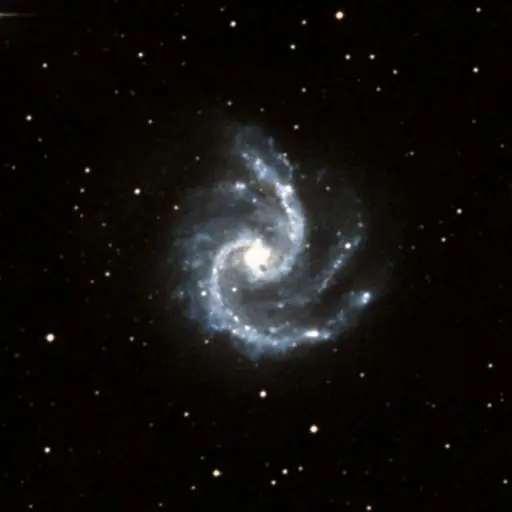
A grand-design spiral that shaped its two great arms with no sign of a neighbour’s meddling.
Some spiral galaxies owe their sweeping arms to the pull of a passing neighbour. NGC 5247 seems to have managed alone: a grand-design spiral with no sign of disturbance by other galaxies. Its two main arms each wrap halfway round the centre, then split in two. We see it nearly face-on. William Herschel found it on 7 February 1785, and two supernovae from collapsing massive stars have been seen here since 2012.
NGC 5247 is 72 million light-years away: the light we see from it set off about 72 million years ago, when dinosaurs still walked the Earth.
How big is it?
About as wide as our Milky Way. Light itself takes 110,000 years to cross it. Shrink it to the length of a football pitch and our whole Solar System would be smaller than a bacterium.
A 10.4-magnitude weakly barred spiral galaxy (SABb) in Virgo, about 5.3′ × 4.3′.
When and where to see it
It is best placed in the evening sky around May, when it crosses the meridian at about 10 pm local time (around midnight in April). It can be seen from everywhere south of 72°N and never sets south of 72°S.
At its highest it stands 22° up from 50°N, 37° up from 35°N, 72° up from the equator, 73° up from 35°S.
Facts
- Type
- Galaxy
- Constellation
- Virgo
- Designations
- NGC 5247
- Magnitude
- 10.4
- Apparent size
- 5.3′ × 4.3′
- Position
- RA 13h 38.1m, Dec −17° 53′ (J2000)
- Distance
- 72 million light-years
- Discovered
- William Herschel, 1785
Open AstroPilot to see when NGC 5247 is highest tonight from your location, how easy it is with your telescope or binoculars, and an eyepiece view.