NGC 524
NGC 524 is a galaxy in the constellation Pisces, magnitude 10.3, 3.4′ × 3.4′ across.
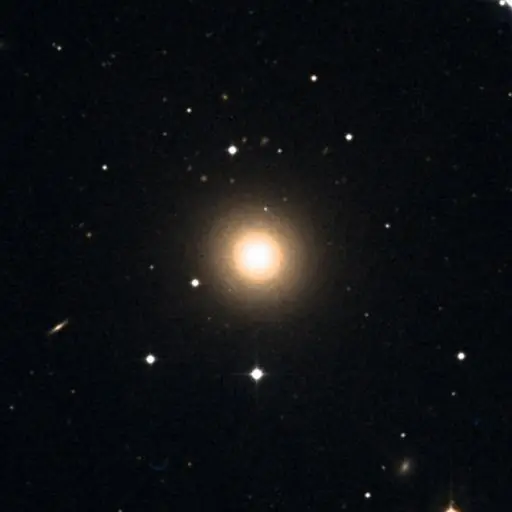
A smooth, lens-shaped galaxy that once slipped behind the eclipsed Moon.
A lenticular galaxy is an in-between: it has a disc like a spiral’s, but little sign of arms. NGC 524 is one, yet deep in its bulge, gas traces a faint spiral pattern of its own. It is the largest galaxy in a small group that keeps company with NGC 488 and its neighbours. William Herschel discovered it on 4 September 1786.
NGC 524 is 78 million light-years away: the light we see from it set off about 78 million years ago, when dinosaurs still walked the Earth.
Did you know?
- Hidden by a red Moon. On 4 May 1985, during a total lunar eclipse, the darkened Moon passed in front of NGC 524 as seen from South Africa and Antarctica.
- Brightest of the year. SN 2000cx, a peculiar Type Ia supernova found here in July 2000, reached magnitude 13.1 — the brightest supernova seen anywhere that year.
How big is it?
76% of the Milky Way’s width. Light itself takes 76,000 years to cross it. Shrink it to the length of a football pitch and our whole Solar System would be smaller than a bacterium.
A 10.3-magnitude lenticular galaxy (S0-a) in Pisces, about 3.4′ across.
When and where to see it
It is best placed in the evening sky around November, when it crosses the meridian at about 10 pm local time (around midnight in October). It can be seen from everywhere north of 80°S and never sets north of 80°N.
At its highest it stands 50° up from 50°N, 65° up from 35°N, 80° up from the equator, 45° up from 35°S.
Facts
- Type
- Galaxy
- Constellation
- Pisces
- Designations
- NGC 524
- Magnitude
- 10.3
- Apparent size
- 3.4′ × 3.4′
- Position
- RA 1h 24.8m, Dec +9° 32′ (J2000)
- Distance
- 78 million light-years
- Discovered
- William Herschel, 1786
Open AstroPilot to see when NGC 524 is highest tonight from your location, how easy it is with your telescope or binoculars, and an eyepiece view.