NGC 5195
NGC 5195 is a galaxy in the constellation Canes Venatici, magnitude 9.6, 5.5′ × 4.4′ across.
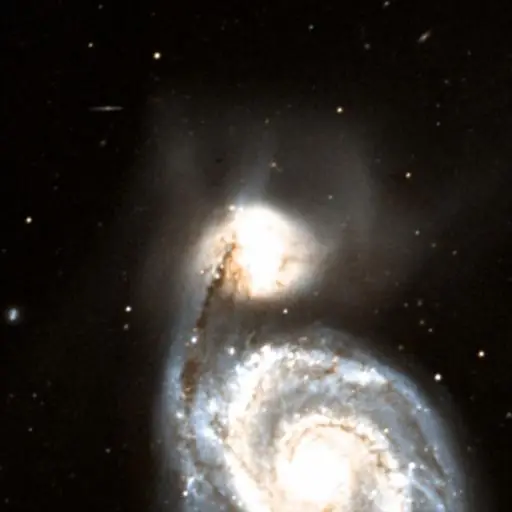
The Whirlpool’s small companion — its pull helped carve the famous spiral, and its black hole is burping gas.
Just behind the Whirlpool Galaxy, M 51, hangs a smaller partner, and it is no bystander. The pull of NGC 5195 has helped sharpen the Whirlpool’s famous spiral arms, while the encounter has left NGC 5195 itself so distorted that astronomers struggle to classify it at all. A dusty bridge joins the two; that dust is seen in silhouette against NGC 5195’s centre, which shows the smaller galaxy lies farther away.
Pierre Méchain, Charles Messier’s colleague, discovered it on 20 March 1781.
NGC 5195 is 25 million light-years away: the light we see from it set off about 25 million years ago, when the Himalayas and the Alps were rising.
Did you know?
- A black hole’s burps. In 2016 astronomers using NASA’s Chandra X-ray telescope reported two huge arcs of hot gas pushed out by the black hole at the centre of NGC 5195, sweeping cooler hydrogen ahead of them — one of the closest examples of a black hole blasting out gas this way.
How big is it?
40% of the Milky Way’s width. Light itself takes 40,000 years to cross it. Shrink it to the length of a football pitch and our whole Solar System would be about the size of a red blood cell.
A 9.6-magnitude barred spiral galaxy (SBa) in Canes Venatici, about 5.5′ × 4.4′.
When and where to see it
It is best placed in the evening sky around May, when it crosses the meridian at about 10 pm local time (around midnight in April). It can be seen from everywhere north of 43°S and never sets north of 43°N.
At its highest it stands 87° up from 50°N, 78° up from 35°N, 43° up from the equator, 8° up from 35°S.
Facts
- Type
- Galaxy
- Constellation
- Canes Venatici
- Designations
- NGC 5195
- Magnitude
- 9.6
- Apparent size
- 5.5′ × 4.4′
- Position
- RA 13h 30.0m, Dec +47° 16′ (J2000)
- Distance
- 25 million light-years
- Discovered
- Pierre Méchain, 1781
Open AstroPilot to see when NGC 5195 is highest tonight from your location, how easy it is with your telescope or binoculars, and an eyepiece view.