NGC 5189 (IC 4274)
NGC 5189 (IC 4274) is a planetary nebula in the constellation Musca, magnitude 10.3 (blue), 2.3′ across.
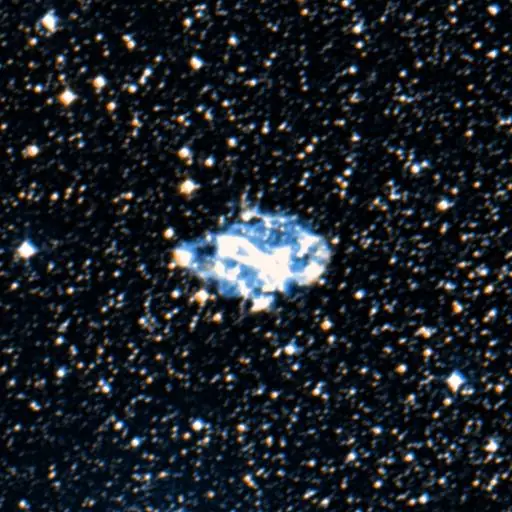
A dying star’s cloud twisted into an S, shaped by a hidden companion on a four-day orbit.
With its tangled S-shape, NGC 5189 looks more like a barred spiral galaxy than the cast-off shell of a star. Well into the 1960s it was taken for an ordinary emission nebula; only in 1967 did Karl Henize, from its spectrum, call it “quasi-planetary”. Today it is classed as a planetary nebula.
The S, with matching knots on opposite sides, long hinted that two stars were at work. The Southern African Large Telescope finally found the partner: a white dwarf circling the rare Wolf-Rayet-type central star every 4.04 days. Hubble images show the S is two dense clumps moving in opposite directions, perhaps thrown out in a recent outburst.
NGC 5189 (IC 4274) is 5,100 light-years away: the light we see from it set off around 3080 BC, around the time the first circle of Stonehenge was raised.
Did you know?
- A twin in another galaxy. A very similar planetary nebula, N66, lies in the Large Magellanic Cloud — and it too has a Wolf-Rayet-type star at its heart.
How big is it?
About as wide as the distance from the Sun to the nearest star. Light itself takes 3.5 years to cross it. Shrink our Solar System — the Sun and all eight planets — to the size of a coin, and NGC 5189 would be 87.2 m across (about the length of a football pitch); the nearest star would be a football pitch away, and the Milky Way 2,520 km across.
A 10.3-magnitude (B-band) planetary nebula in Musca, about 2.3′ across. Its central star is magnitude 14.9 (B-band).
When and where to see it
It is best placed in the evening sky around May, when it crosses the meridian at about 10 pm local time (around midnight in April). It can be seen from everywhere south of 24°N and never sets south of 24°S.
At its highest it stands below the horizon from 50°N, below the horizon from 35°N, 24° up from the equator, 59° up from 35°S.
Facts
- Type
- Planetary nebula
- Constellation
- Musca
- Designations
- IC 4274
- Magnitude
- 10.3 (blue)
- Apparent size
- 2.3′
- Position
- RA 13h 33.5m, Dec −65° 58′ (J2000)
- Distance
- 5,100 light-years
- Discovered
- James Dunlop, 1826
Open AstroPilot to see when NGC 5189 (IC 4274) is highest tonight from your location, how easy it is with your telescope or binoculars, and an eyepiece view.