Centaurus A (NGC 5128)
Centaurus A (NGC 5128) is a galaxy in the constellation Centaurus, magnitude 7.2, 26′ × 20′ across.
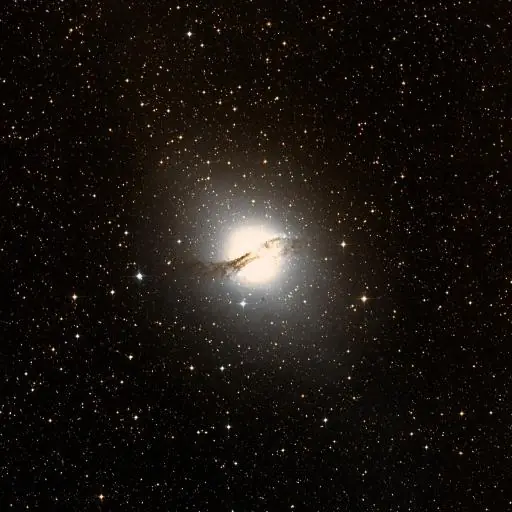
The nearest radio galaxy: a cosmic collision with a black hole firing jets at half the speed of light.
In 1949 three radio astronomers in Australia — John Bolton, Bruce Slee and Gordon Stanley — traced a source of radio waves to NGC 5128, making it one of the first radio sources ever matched to another galaxy. Centaurus A is still the closest radio galaxy to Earth. Its power comes from a black hole of about 55 million Suns, which fires jets of particles; radio images taken a decade apart show the inner jet moving at about half the speed of light.
Five years after the radio discovery, Walter Baade and Rudolph Minkowski suggested that its odd look was the scar of a collision: a giant elliptical galaxy swallowing a smaller spiral. Models still back the idea. Its dusty disc is busy making stars — Hubble found young blue stars along it, and over 100 star-forming regions have been counted.
James Dunlop discovered it on 29 April 1826 from his home in Parramatta, New South Wales.
Centaurus A (NGC 5128) is 11 million light-years away: the light we see from it set off about 11 million years ago, when great apes were spreading through Africa and Europe.
Did you know?
- A portrait of the jet. In July 2021 the Event Horizon Telescope — the network that photographed the black hole in M 87 — released a sharp radio image of Centaurus A’s jet as it leaves the black hole.
- A supernova that broke the mould. The Australian amateur Robert Evans found SN 1986G in the dust lane on 3 May 1986. It showed that Type Ia supernovae are not all identical, and can differ in how they brighten and fade.
- Cosmic-ray suspect. In 2010, after years of observations, the Pierre Auger Observatory pointed to Centaurus A as a source of the highest-energy cosmic rays reaching Earth.
- Cores of eaten galaxies. Some of its apparent globular clusters may be the stripped cores of galaxies it consumed. One, VHH81-01, seems to hold a black hole of around 800,000 Suns.
How big is it?
83% of the Milky Way’s width. Light itself takes 83,000 years to cross it. Shrink it to the length of a football pitch and our whole Solar System would be smaller than a bacterium.
A giant elliptical galaxy crossed by a broad dark dust lane, the result of a merger; one of the brightest galaxies in the sky and a powerful radio source.
When and where to see it
It is best placed in the evening sky around May, when it crosses the meridian at about 10 pm local time (around midnight in April). It can be seen from everywhere south of 47°N and never sets south of 47°S.
At its highest it stands below the horizon from 50°N, 12° up from 35°N, 47° up from the equator, 82° up from 35°S.
Facts
- Type
- Galaxy
- Constellation
- Centaurus
- Designations
- NGC 5128, C 77
- Magnitude
- 7.2
- Apparent size
- 26′ × 20′
- Position
- RA 13h 25.5m, Dec −43° 1′ (J2000)
- Distance
- 11 million light-years
- Discovered
- James Dunlop, 1826
Open AstroPilot to see when Centaurus A (NGC 5128) is highest tonight from your location, how easy it is with your telescope or binoculars, and an eyepiece view.