NGC 5101
NGC 5101 is a galaxy in the constellation Hydra, magnitude 10.5, 5.9′ × 5.5′ across.
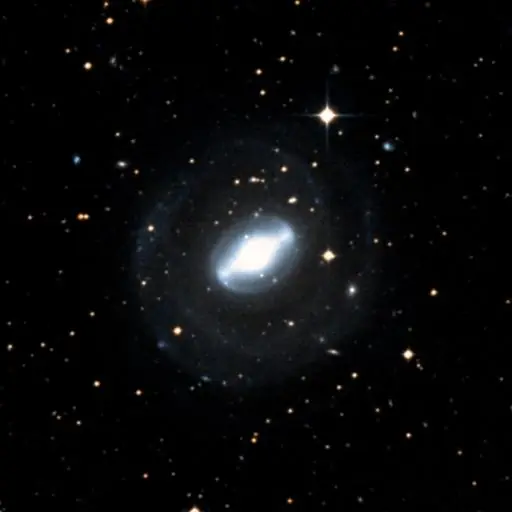
A disc galaxy in Hydra with a Milky Way-sized neighbour just half a degree away.
Half a degree away on the sky lies the spiral NGC 5078, and the two are thought to be at the same distance — true neighbours, each roughly the size of the Milky Way. NGC 5101 is a lenticular galaxy, a disc of stars without spiral arms, and both belong to the ten-strong NGC 5061 group. William Herschel found it on 28 March 1786. A supernova was seen here in 1986.
NGC 5101 is 53 million light-years away: the light we see from it set off about 53 million years ago, when mammals were taking over a world without dinosaurs.
How big is it?
About as wide as our Milky Way. Light itself takes 91,000 years to cross it. Shrink it to the length of a football pitch and our whole Solar System would be smaller than a bacterium.
A 10.5-magnitude lenticular galaxy (S0-a) in Hydra, about 5.9′ × 5.5′.
When and where to see it
It is best placed in the evening sky around May, when it crosses the meridian at about 10 pm local time (around midnight in April). It can be seen from everywhere south of 63°N and never sets south of 63°S.
At its highest it stands 13° up from 50°N, 28° up from 35°N, 63° up from the equator, 82° up from 35°S.
Facts
- Type
- Galaxy
- Constellation
- Hydra
- Designations
- NGC 5101
- Magnitude
- 10.5
- Apparent size
- 5.9′ × 5.5′
- Position
- RA 13h 21.8m, Dec −27° 26′ (J2000)
- Distance
- 53 million light-years
- Discovered
- William Herschel, 1786
Open AstroPilot to see when NGC 5101 is highest tonight from your location, how easy it is with your telescope or binoculars, and an eyepiece view.