NGC 5084
NGC 5084 is a galaxy in the constellation Virgo, magnitude 10.5, 9.9′ × 2.5′ across.
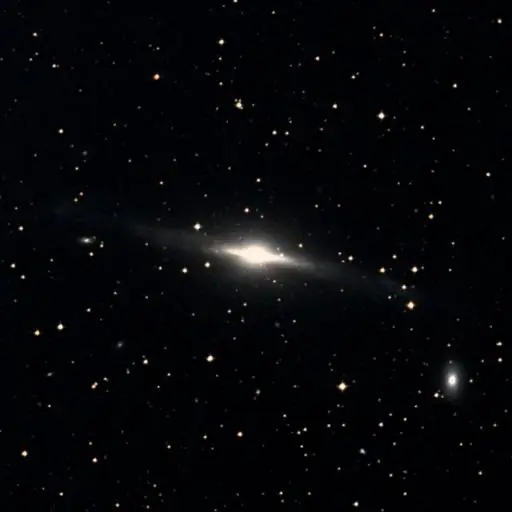
A heavyweight disc galaxy — one of the largest and most massive in the Virgo Supercluster.
Seen almost exactly edge-on, NGC 5084 doesn’t look like a record-holder. Yet this lenticular galaxy is one of the largest and most massive in the Virgo Supercluster. Its disc spins at about 330 kilometres per second, and estimates of its mass start at around a trillion Suns. Large amounts of hydrogen gas along its warped disc suggest it has absorbed several smaller galaxies. William Herschel found it on 10 March 1785.
NGC 5084 is 60 million light-years away: the light we see from it set off about 60 million years ago, when mammals were taking over a world without dinosaurs.
Did you know?
- Weighed by its satellites. In 1997 astronomers measured the motions of nine satellite galaxies around NGC 5084. Their result was the highest mass derived for any disc galaxy at the time.
How big is it?
1.7 times as wide as our Milky Way. Light itself takes 170,000 years to cross it. Shrink it to the length of a football pitch and our whole Solar System would be smaller than a bacterium. All told — stars, gas and dark matter — it weighs about 6 trillion Suns.
A 10.5-magnitude lenticular galaxy (S0) in Virgo, about 9.9′ × 2.5′.
When and where to see it
It is best placed in the evening sky around May, when it crosses the meridian at about 10 pm local time (around midnight in April). It can be seen from everywhere south of 68°N and never sets south of 68°S.
At its highest it stands 18° up from 50°N, 33° up from 35°N, 68° up from the equator, 77° up from 35°S.
Facts
- Type
- Galaxy
- Constellation
- Virgo
- Designations
- NGC 5084
- Magnitude
- 10.5
- Apparent size
- 9.9′ × 2.5′
- Position
- RA 13h 20.3m, Dec −21° 50′ (J2000)
- Distance
- 60 million light-years
- Discovered
- William Herschel, 1785
Open AstroPilot to see when NGC 5084 is highest tonight from your location, how easy it is with your telescope or binoculars, and an eyepiece view.