NGC 5068
NGC 5068 is a galaxy in the constellation Virgo, magnitude 10.1, 7.5′ × 6.7′ across.
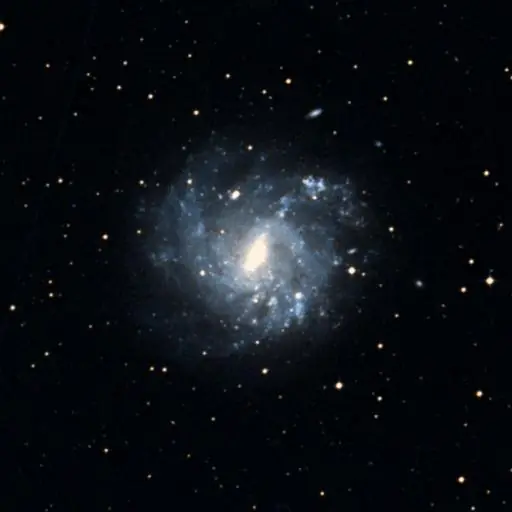
A face-on spiral where, in 2020, two stars probably merged in a flash of red light.
No supernova has yet been seen in NGC 5068, but in April 2020 the ATLAS survey caught something stranger: a luminous red nova. These outbursts are thought to happen when two stars in a close pair spiral together and merge, throwing off a cool, reddish glow brighter than an ordinary nova. The galaxy itself is a barred spiral that we see face-on, discovered by William Herschel on 10 March 1785.
NGC 5068 is 21 million light-years away: the light we see from it set off about 21 million years ago, when the Himalayas and the Alps were rising.
How big is it?
46% of the Milky Way’s width. Light itself takes 46,000 years to cross it. Shrink it to the length of a football pitch and our whole Solar System would be about the size of a red blood cell.
A 10.1-magnitude spiral galaxy (Sc) in Virgo, about 7.5′ × 6.7′.
When and where to see it
It is best placed in the evening sky around May, when it crosses the meridian at about 10 pm local time (around midnight in April). It can be seen from everywhere south of 69°N and never sets south of 69°S.
At its highest it stands 19° up from 50°N, 34° up from 35°N, 69° up from the equator, 76° up from 35°S.
Facts
- Type
- Galaxy
- Constellation
- Virgo
- Designations
- NGC 5068
- Magnitude
- 10.1
- Apparent size
- 7.5′ × 6.7′
- Position
- RA 13h 18.9m, Dec −21° 2′ (J2000)
- Distance
- 21 million light-years
- Discovered
- William Herschel, 1785
Open AstroPilot to see when NGC 5068 is highest tonight from your location, how easy it is with your telescope or binoculars, and an eyepiece view.