NGC 5061
NGC 5061 is a galaxy in the constellation Hydra, magnitude 10.3, 3.8′ × 3.0′ across.
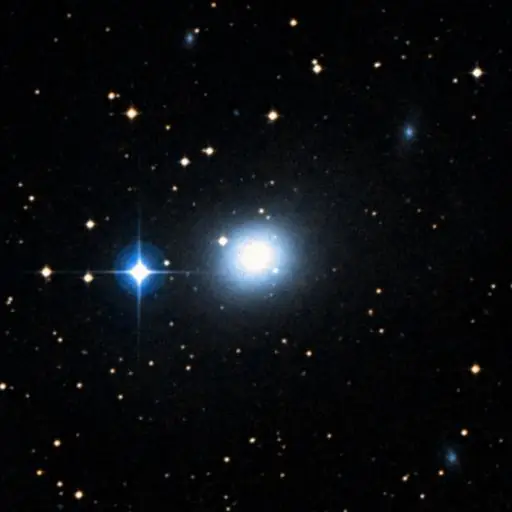
An elliptical galaxy in Hydra that hosted the brightest supernova of 1996.
In April 1996 a white dwarf in NGC 5061 blew itself apart. Reaching magnitude 13, SN 1996X was the brightest supernova of that year. One of its discoverers was Robert Evans, an Australian minister who found dozens of supernovae by eye, having memorised the look of hundreds of galaxies.
The galaxy itself is an elliptical with a Seyfert nucleus — a compact, active core — and it heads a group of about ten galaxies. William Herschel found it on 28 March 1786.
NGC 5061 is 80 million light-years away: the light we see from it set off about 80 million years ago, when dinosaurs still walked the Earth.
How big is it?
About as wide as our Milky Way. Light itself takes 87,000 years to cross it. Shrink it to the length of a football pitch and our whole Solar System would be smaller than a bacterium.
A 10.3-magnitude elliptical galaxy (E) in Hydra, about 3.8′ × 3.1′.
When and where to see it
It is best placed in the evening sky around May, when it crosses the meridian at about 10 pm local time (around midnight in April). It can be seen from everywhere south of 63°N and never sets south of 63°S.
At its highest it stands 13° up from 50°N, 28° up from 35°N, 63° up from the equator, 82° up from 35°S.
Facts
- Type
- Galaxy
- Constellation
- Hydra
- Designations
- NGC 5061
- Magnitude
- 10.3
- Apparent size
- 3.8′ × 3.0′
- Position
- RA 13h 18.1m, Dec −26° 50′ (J2000)
- Distance
- 80 million light-years
- Discovered
- William Herschel, 1786
Open AstroPilot to see when NGC 5061 is highest tonight from your location, how easy it is with your telescope or binoculars, and an eyepiece view.