NGC 5005 (C 29)
NGC 5005 (C 29) is a galaxy in the constellation Canes Venatici, magnitude 9.8, 4.8′ × 1.5′ across.
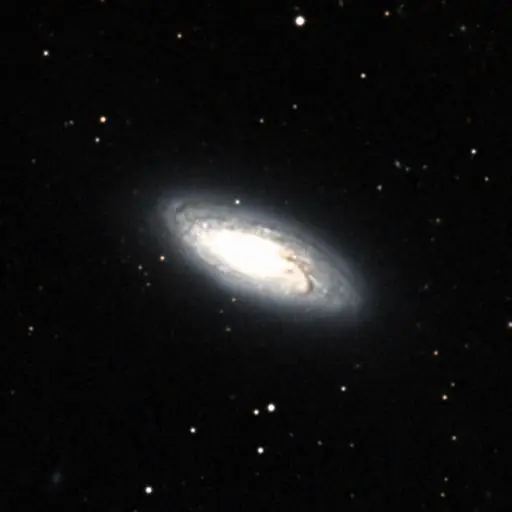
A dusty spiral whose flickering X-ray heart gives away a supermassive black hole.
Something in the heart of NGC 5005 is flickering. X-ray telescopes have found a point-like source of hard X-rays in its nucleus that varies in brightness — the signature of hot, squeezed gas swirling just outside a supermassive black hole.
That matters because of a long argument. NGC 5005 has a LINER nucleus, a type that glows with weakly ionised gas, and astronomers have debated for years what powers such cores: a feeding black hole, or bursts of star birth? In this spiral galaxy, at least, the X-rays show that a supermassive black hole is there.
William Herschel discovered NGC 5005 on 1 May 1785.
NGC 5005 (C 29) is 64 million light-years away: the light we see from it set off about 64 million years ago, when mammals were taking over a world without dinosaurs.
Did you know?
- A gentle partnership. NGC 5005 and the nearby spiral NGC 5033 form a true physical pair. They tug on each other only weakly, and are not yet close enough to be pulled out of shape.
- A 1996 supernova. Claudio Bottari discovered SN 1996ai in NGC 5005 on 16 June 1996. It was a Type Ia supernova, the kind that comes from an exploding white dwarf.
How big is it?
About as wide as our Milky Way. Light itself takes 90,000 years to cross it. Shrink it to the length of a football pitch and our whole Solar System would be smaller than a bacterium.
A bright, inclined spiral in Canes Venatici showing an elongated glow with a bright core.
When and where to see it
It is best placed in the evening sky around May, when it crosses the meridian at about 10 pm local time (around midnight in April). It can be seen from everywhere north of 53°S and never sets north of 53°N.
At its highest it stands 77° up from 50°N, 88° up from 35°N, 53° up from the equator, 18° up from 35°S.
Facts
- Type
- Galaxy
- Constellation
- Canes Venatici
- Designations
- C 29
- Magnitude
- 9.8
- Apparent size
- 4.8′ × 1.5′
- Position
- RA 13h 10.9m, Dec +37° 4′ (J2000)
- Distance
- 64 million light-years
- Discovered
- William Herschel, 1785
Open AstroPilot to see when NGC 5005 (C 29) is highest tonight from your location, how easy it is with your telescope or binoculars, and an eyepiece view.