NGC 4976
NGC 4976 is a galaxy in the constellation Centaurus, magnitude 10.1, 5.8′ × 3.3′ across.
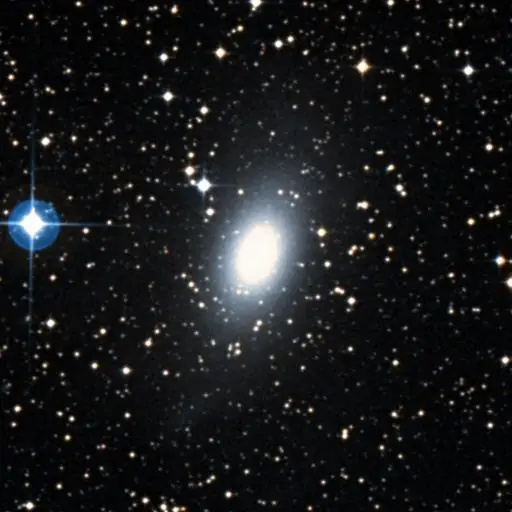
A southern elliptical galaxy that doesn’t quite fit the standard mould.
John Herschel came across NGC 4976 on 31 March 1835, during his four-year survey of the southern sky from the Cape of Good Hope. It is classed as a peculiar elliptical galaxy — a smooth, rounded swarm of stars, but with something in its shape or structure that departs from the textbook pattern.
NGC 4976 is 76 million light-years away: the light we see from it set off about 76 million years ago, when dinosaurs still walked the Earth.
How big is it?
1.3 times as wide as our Milky Way. Light itself takes 130,000 years to cross it. Shrink it to the length of a football pitch and our whole Solar System would be smaller than a bacterium.
A 10.1-magnitude elliptical galaxy (E) in Centaurus, about 5.8′ × 3.3′.
When and where to see it
It is best placed in the evening sky around May, when it crosses the meridian at about 10 pm local time (around midnight in April). It can be seen from everywhere south of 40°N and never sets south of 40°S.
At its highest it stands below the horizon from 50°N, 5° up from 35°N, 40° up from the equator, 75° up from 35°S.
Facts
- Type
- Galaxy
- Constellation
- Centaurus
- Designations
- NGC 4976
- Magnitude
- 10.1
- Apparent size
- 5.8′ × 3.3′
- Position
- RA 13h 8.6m, Dec −49° 30′ (J2000)
- Distance
- 76 million light-years
- Discovered
- John Herschel, 1835
Open AstroPilot to see when NGC 4976 is highest tonight from your location, how easy it is with your telescope or binoculars, and an eyepiece view.