NGC 4945 (C 83)
NGC 4945 (C 83) is a galaxy in the constellation Centaurus, magnitude 9.3 (blue), 23′ × 4.0′ across.
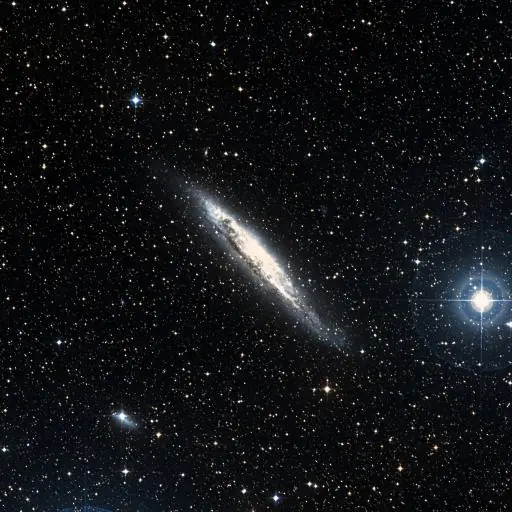
A Milky Way look-alike seen edge-on, with a dust-hidden active core, a starburst — and a song named after it.
Visible light cannot escape the dusty heart of NGC 4945, yet it holds one of the nearest active galactic nuclei to Earth. X-rays and infrared get through: in hard X-rays only NGC 4151 outshines it, and in 1979 astronomers picked up a powerful water maser — a natural microwave laser — from its centre.
The core is doubly busy. Beside the active nucleus a starburst is under way, and so many stars have exploded there that their winds have probably hollowed out a cone-shaped cavity. A hot wind carries away about 1.6 Suns’ worth of gas every year.
Seen exactly edge-on, NGC 4945 is thought to resemble our own Milky Way. It was the first galaxy beyond the Local Group whose halo stars could be picked out one by one — and that halo seems to turn the opposite way to the disc, a sign it was built from a swallowed galaxy about as massive as the Large Magellanic Cloud.
NGC 4945 (C 83) is 12 million light-years away: the light we see from it set off about 12 million years ago, when great apes were spreading through Africa and Europe.
Did you know?
- Punctum. In 2023 ALMA found a mysterious point of radio light near the galaxy’s centre, named Punctum — Latin for ‘dot’. A 2025 paper said it most resembles a magnetar, though magnetars are usually much fainter at those wavelengths.
- A song of its own. ‘NGC 4945’ is the title of a song by Brett Domino, on the album Funk.
How big is it?
81% of the Milky Way’s width. Light itself takes 81,000 years to cross it. Shrink it to the length of a football pitch and our whole Solar System would be smaller than a bacterium. All told — stars, gas and dark matter — it weighs about 140 billion Suns.
A large edge-on spiral in Centaurus with an active nucleus, showing as a long, bright streak in a telescope.
When and where to see it
It is best placed in the evening sky around May, when it crosses the meridian at about 10 pm local time (around midnight in April). It can be seen from everywhere south of 41°N and never sets south of 41°S.
At its highest it stands below the horizon from 50°N, 6° up from 35°N, 41° up from the equator, 76° up from 35°S.
Facts
- Type
- Galaxy
- Constellation
- Centaurus
- Designations
- C 83
- Magnitude
- 9.3 (blue)
- Apparent size
- 23′ × 4.0′
- Position
- RA 13h 5.5m, Dec −49° 28′ (J2000)
- Distance
- 12 million light-years
- Discovered
- James Dunlop, 1826
Open AstroPilot to see when NGC 4945 (C 83) is highest tonight from your location, how easy it is with your telescope or binoculars, and an eyepiece view.