Coma B (NGC 4889)
Coma B (NGC 4889) is a galaxy in the constellation Coma Berenices, magnitude 11.4, 2.6′ × 1.7′ across.
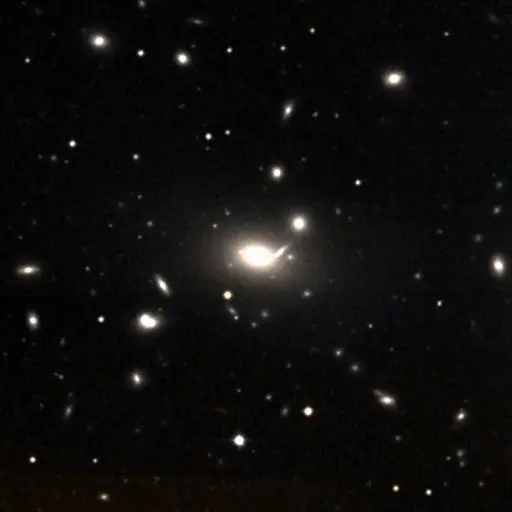
A supergiant galaxy at the heart of the Coma Cluster, hiding one of the heaviest black holes ever weighed.
At the core of NGC 4889 sits one of the most massive black holes on record: around 21 billion times the mass of the Sun by the best estimate, some 5,200 times heavier than the one at the centre of the Milky Way. Its event horizon alone may be two to twelve times as wide as the orbit of Pluto.
The galaxy around it is a supergiant elliptical galaxy, probably built from many smaller galaxies that merged. Its stars, nearly all old, swarm in random orbits rather than a neat spinning disc, which keeps it egg-shaped. It may once have blazed as a quasar; now its black hole is quiet, having apparently eaten everything within easy reach.
It shares the centre of the Coma Cluster, a swarm of some 2,000 galaxies, with its rival NGC 4874. William Herschel, helped by his sister Caroline, recorded it in 1785.
Coma B (NGC 4889) is 320 million light-years away: the light we see from it set off about 320 million years ago, when the first plants and animals were moving onto land.
Did you know?
- A swarm of star clusters. About 15,800 globular clusters orbit NGC 4889 — more than the 12,000 of the giant galaxy M 87, but only half as many as its neighbour NGC 4874.
- Counted twice. Dreyer’s New General Catalogue of 1888 accidentally listed it twice, as NGC 4884 and NGC 4889. Later revisions caught the slip, and the second number stuck.
- Missed by Messier. Charles Messier never listed it, though it is intrinsically bright and near some of his objects in the sky. In 1995 Patrick Moore made it number 35 in his Caldwell catalogue.
How big is it?
2.4 times as wide as our Milky Way. Light itself takes 240,000 years to cross it. Shrink it to the length of a football pitch and our whole Solar System would be smaller than a bacterium.
The brightest galaxy in the Coma Cluster, about 300 million light-years away: a small oval glow among dozens of faint galaxies.
When and where to see it
It is best placed in the evening sky around May, when it crosses the meridian at about 10 pm local time (around midnight in April). It can be seen from everywhere north of 62°S and never sets north of 62°N.
At its highest it stands 68° up from 50°N, 83° up from 35°N, 62° up from the equator, 27° up from 35°S.
Facts
- Type
- Galaxy
- Constellation
- Coma Berenices
- Designations
- NGC 4889, NGC 4884, C 35
- Magnitude
- 11.4
- Apparent size
- 2.6′ × 1.7′
- Position
- RA 13h 0.1m, Dec +27° 59′ (J2000)
- Distance
- 320 million light-years
- Discovered
- William Herschel, 1785, Assisted by Caroline Herschel
Open AstroPilot to see when Coma B (NGC 4889) is highest tonight from your location, how easy it is with your telescope or binoculars, and an eyepiece view.