NGC 488
NGC 488 is a galaxy in the constellation Pisces, magnitude 10.3, 5.0′ × 3.7′ across.
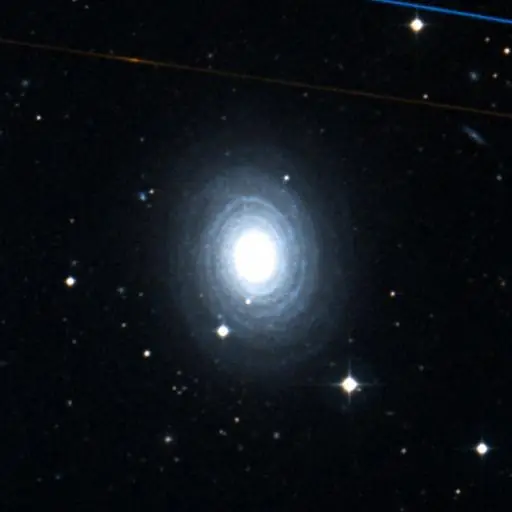
A model many-armed spiral, its tightly wound arms wrapped round a huge bulge.
Seen almost face-on, NGC 488 shows a pattern astronomers treat as a textbook case: many thin, tightly wound arms around a large, bright central bulge. It is considered a prototype of the multi-arm spiral galaxy. Its very centre is a surprise: the nucleus is twice as rich in heavy elements as the bulge around it, chemically set apart from its surroundings.
William Herschel discovered it on 13 December 1784. It gives its name to a small, isolated group of at least seven galaxies.
NGC 488 is 96 million light-years away: the light we see from it set off about 96 million years ago, when dinosaurs still walked the Earth.
Did you know?
- Two supernovae. SN 1976G was found by Miklós Lovas and, two days later, independently by Paul Wild in Switzerland. SN 2010eb, a Type Ia, was spotted in 2010 by the South African amateur Berto Monard.
How big is it?
1.4 times as wide as our Milky Way. Light itself takes 140,000 years to cross it. Shrink it to the length of a football pitch and our whole Solar System would be smaller than a bacterium.
A 10.3-magnitude spiral galaxy (Sb) in Pisces, about 5.1′ × 3.7′.
When and where to see it
It is best placed in the evening sky around November, when it crosses the meridian at about 10 pm local time (around midnight in October). It can be seen from everywhere north of 85°S and never sets north of 85°N.
At its highest it stands 45° up from 50°N, 60° up from 35°N, 85° up from the equator, 50° up from 35°S.
Facts
- Type
- Galaxy
- Constellation
- Pisces
- Designations
- NGC 488
- Magnitude
- 10.3
- Apparent size
- 5.0′ × 3.7′
- Position
- RA 1h 21.8m, Dec +5° 15′ (J2000)
- Distance
- 96 million light-years
- Discovered
- William Herschel, 1784
Open AstroPilot to see when NGC 488 is highest tonight from your location, how easy it is with your telescope or binoculars, and an eyepiece view.