Jewel Box (NGC 4755)
Jewel Box (NGC 4755) is an open cluster in the constellation Crux, magnitude 4.2, 10′ across.
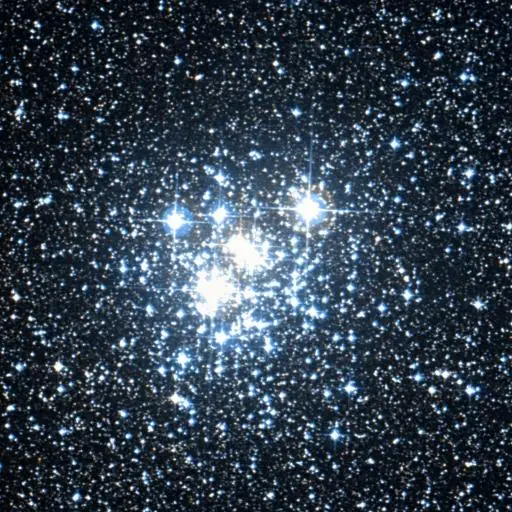
Young supergiants in Crux, named a jewel box by John Herschel for their contrasting colours.
Fourteen million years ago — long after the dinosaurs, but before the first humans — a cloud of gas in Crux gave birth to the stars of the Jewel Box. That makes it one of the youngest known open clusters. Its brightest members are supergiants, among the most luminous stars in the Milky Way.
Nicolas-Louis de Lacaille found it in 1751–52 from the Cape of Good Hope, using a telescope only half an inch across. To the naked eye it looks like a hazy star, which is why it carries a star’s name, Kappa Crucis — but Lacaille was the first to see that it was a group of many stars.
John Herschel gave it its popular name, and between 1834 and 1838 he recorded the positions of just over 100 of its stars.
Jewel Box (NGC 4755) is 6,500 light-years away: the light we see from it set off around 4480 BC, 1,030 years after the first towns were growing in the Fertile Crescent.
Did you know?
- The traffic lights. Across the bar of the cluster’s A-shaped pattern, three stars in a row are nicknamed the traffic lights for their different colours. One is DU Crucis, a red supergiant; another, BU Crucis, is an eclipsing binary.
- A bright outsider. DS Crucis, the brightest star in the cluster’s area, is probably not a member at all but a supergiant lying in the foreground.
- Hard to measure. The Jewel Box’s distance is tricky to pin down, because the dark Coalsack Nebula nearby dims some of its light.
How big is it?
Born about 12 million years ago, when great apes were spreading through Africa and Europe. Light itself takes 19 years to cross it. Gaia has picked out 724 stars moving together through space as its members. That’s 4.5 times the distance from the Sun to the nearest star. Shrink our Solar System — the Sun and all eight planets — to the size of a coin, and Jewel Box would be 477 m across (5 football pitches end to end); the nearest star would be a football pitch away, and the Milky Way 2,520 km across.
A small, brilliant open cluster beside Beta Crucis (Mimosa); its blue-white stars and one orange supergiant reminded John Herschel of “a superb piece of fancy jewellery”.
When and where to see it
It is best placed in the evening sky around May, when it crosses the meridian at about 10 pm local time (around midnight in April). It can be seen from everywhere south of 30°N and never sets south of 30°S.
At its highest it stands below the horizon from 50°N, below the horizon from 35°N, 30° up from the equator, 65° up from 35°S.
Facts
- Type
- Open cluster
- Constellation
- Crux
- Designations
- NGC 4755, C 94, Mel 114, Cr 264, Herschel's Jewel Box, Kappa Crucis Cluster, Melotte 114, Collinder 264
- Magnitude
- 4.2
- Apparent size
- 10′
- Position
- RA 12h 53.6m, Dec −60° 21′ (J2000)
- Distance
- 6,500 light-years
- Discovered
- Nicolas-Louis de Lacaille, 1751, Observed from the Cape of Good Hope in 1751–52
Open AstroPilot to see when Jewel Box (NGC 4755) is highest tonight from your location, how easy it is with your telescope or binoculars, and an eyepiece view.