NGC 4725
NGC 4725 is a galaxy in the constellation Coma Berenices, magnitude 9.4, 9.7′ × 7.1′ across.
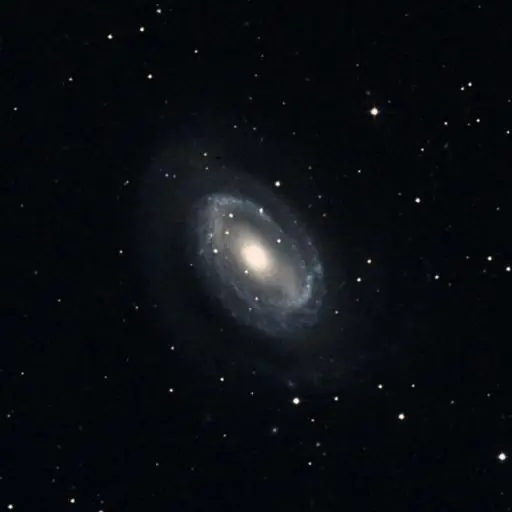
A ringed spiral where, in 2016, a would-be supernova turned out to be the dwarf planet Makemake.
A single ring of star formation encircles the bar of NGC 4725, slightly off-centre and moving in non-circular paths. Look closer and there are two bars, one inside the other — a feature found in about a third of barred spirals. The galaxy is the brightest of the Coma I Group and is being disturbed by its neighbour NGC 4747, which trails a tidal plume towards it. William Herschel found it on 6 April 1785.
NGC 4725 is 40 million light-years away: the light we see from it set off about 40 million years ago, when mammals were taking over a world without dinosaurs.
Did you know?
- Not a supernova. In July 2016 an automated survey spotted a new point of light near NGC 4725 and flagged it as a possible supernova. It was the dwarf planet Makemake, drifting past far out in our own Solar System.
How big is it?
About as wide as our Milky Way. Light itself takes 110,000 years to cross it. Shrink it to the length of a football pitch and our whole Solar System would be smaller than a bacterium.
A 9.4-magnitude weakly barred spiral galaxy (SABa) in Coma Berenices, about 9.7′ × 7.1′.
When and where to see it
It is best placed in the evening sky around May, when it crosses the meridian at about 10 pm local time (around midnight in April). It can be seen from everywhere north of 64°S and never sets north of 64°N.
At its highest it stands 66° up from 50°N, 81° up from 35°N, 64° up from the equator, 29° up from 35°S.
Facts
- Type
- Galaxy
- Constellation
- Coma Berenices
- Designations
- NGC 4725
- Magnitude
- 9.4
- Apparent size
- 9.7′ × 7.1′
- Position
- RA 12h 50.4m, Dec +25° 30′ (J2000)
- Distance
- 40 million light-years
- Discovered
- William Herschel, 1785
Open AstroPilot to see when NGC 4725 is highest tonight from your location, how easy it is with your telescope or binoculars, and an eyepiece view.