NGC 4699
NGC 4699 is a galaxy in the constellation Virgo, magnitude 9.5, 4.0′ × 3.0′ across.
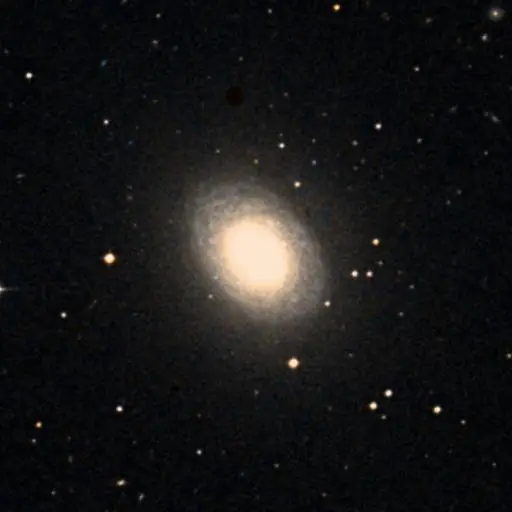
A galaxy with a smaller spiral disc tucked inside its bulge — and a supernova found by Edwin Hubble.
Look into the bright centre of NGC 4699 and there is a second, smaller disc inside it, wound with its own tightly wrapped spiral arms. Around it lie a bar, a ring and many glowing clouds of star birth, while a faint, thick outer disc stretches far beyond. William Herschel found this spiral galaxy in 1786. It belongs to the Virgo II Groups, an extension of the Virgo Cluster.
NGC 4699 is 75 million light-years away: the light we see from it set off about 75 million years ago, when dinosaurs still walked the Earth.
Did you know?
- Edwin Hubble’s supernova. On 5 March 1948 Edwin Hubble himself discovered a supernova in NGC 4699 — the first of three seen here so far.
- A star wrapped in a shell. Supernova 1983K brightened from magnitude 17 to 14 in four days. Its changing spectrum suggested the star had been surrounded by a shell of material before it exploded.
How big is it?
About as wide as our Milky Way. Light itself takes 87,000 years to cross it. Shrink it to the length of a football pitch and our whole Solar System would be smaller than a bacterium.
A 9.5-magnitude weakly barred spiral galaxy (SABb) in Virgo, about 4′ × 3′.
When and where to see it
It is best placed in the evening sky around May, when it crosses the meridian at about 10 pm local time (around midnight in April). It can be seen from everywhere south of 81°N and never sets south of 81°S.
At its highest it stands 31° up from 50°N, 46° up from 35°N, 81° up from the equator, 64° up from 35°S.
Facts
- Type
- Galaxy
- Constellation
- Virgo
- Designations
- NGC 4699
- Magnitude
- 9.5
- Apparent size
- 4.0′ × 3.0′
- Position
- RA 12h 49.0m, Dec −8° 40′ (J2000)
- Distance
- 75 million light-years
- Discovered
- William Herschel, 1786
Open AstroPilot to see when NGC 4699 is highest tonight from your location, how easy it is with your telescope or binoculars, and an eyepiece view.