NGC 4697 (C 52)
NGC 4697 (C 52) is a galaxy in the constellation Virgo, magnitude 9.4, 7.1′ × 4.2′ across.
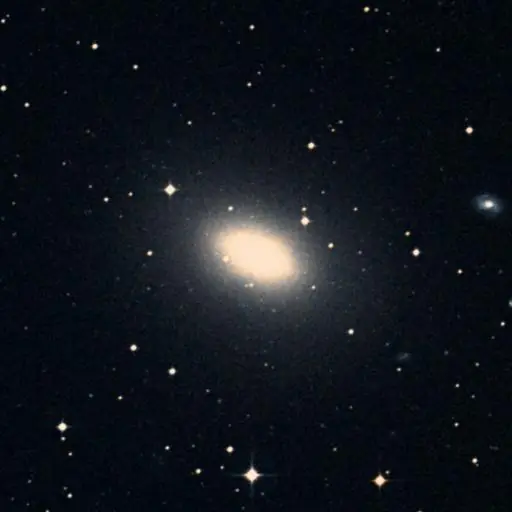
A galaxy the eclipsed Moon keeps covering — in 1950, 1996 and 2015, and next in 2080.
Three times since 1950, a total lunar eclipse and an occultation of this galaxy have happened together: the darkened Moon slid in front of NGC 4697 in April 1950, April 1996 and April 2015. The next time will be on 4 April 2080, seen from the Pacific Ocean, including Hawaii.
Behind that coincidence lies an elliptical galaxy with a heavy heart. At its centre sits a black hole of about 130 million Suns, weighed by the ALMA telescope array, which tracked a disc of gas whirling around it.
William Herschel found NGC 4697 on 24 April 1784. It gives its name to a group of galaxies — one of many that together form a southern extension of the Virgo Supercluster.
NGC 4697 (C 52) is 38 million light-years away: the light we see from it set off about 38 million years ago, when the Himalayas and the Alps were rising.
Did you know?
- Itagaki’s supernova. The prolific Japanese supernova hunter Kōichi Itagaki discovered SN 2018imd in NGC 4697 on 14 November 2018 — a Type Ia supernova, the only one yet recorded here.
- Uncertain distance. Astronomers still disagree about how far away NGC 4697 is: different measurements vary by more than a factor of two.
How big is it?
79% of the Milky Way’s width. Light itself takes 79,000 years to cross it. Shrink it to the length of a football pitch and our whole Solar System would be smaller than a bacterium.
A bright elliptical galaxy in Virgo, an oval glow with a bright core.
When and where to see it
It is best placed in the evening sky around May, when it crosses the meridian at about 10 pm local time (around midnight in April). It can be seen from everywhere south of 84°N and never sets south of 84°S.
At its highest it stands 34° up from 50°N, 49° up from 35°N, 84° up from the equator, 61° up from 35°S.
Facts
- Type
- Galaxy
- Constellation
- Virgo
- Designations
- C 52
- Magnitude
- 9.4
- Apparent size
- 7.1′ × 4.2′
- Position
- RA 12h 48.6m, Dec −5° 48′ (J2000)
- Distance
- 38 million light-years
- Discovered
- William Herschel, 1784
Open AstroPilot to see when NGC 4697 (C 52) is highest tonight from your location, how easy it is with your telescope or binoculars, and an eyepiece view.