Hockey Stick Galaxy (NGC 4656)
Hockey Stick Galaxy (NGC 4656) is a galaxy in the constellation Canes Venatici, magnitude 9.8 (blue), 6.5′ × 40″ across.
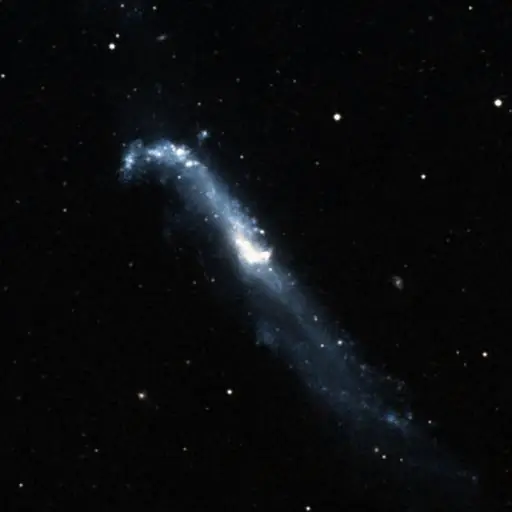
A galaxy bent into a hockey stick by a gravitational tussle with its neighbour, the Whale.
Most edge-on galaxies look like straight needles. NGC 4656 has a crook at one end, which has earned it the names Hockey Stick, Fish Hook and Crowbar; the bent end was catalogued separately as NGC 4657. The warp is thought to come from encounters with its neighbours NGC 4631, the Whale Galaxy, and NGC 4627. Together they form the NGC 4631 Group. William Herschel found it in 1787.
Hockey Stick Galaxy (NGC 4656) is 25 million light-years away: the light we see from it set off about 25 million years ago, when the Himalayas and the Alps were rising.
Did you know?
- A star in super-outburst. On 21 March 2005 astronomers found a luminous blue variable here — a rare, unstable and very massive star — caught in a “super-outburst”.
How big is it?
47% of the Milky Way’s width. Light itself takes 47,000 years to cross it. Shrink it to the length of a football pitch and our whole Solar System would be about the size of a red blood cell.
A 9.8-magnitude (B-band) barred Magellanic spiral galaxy (SBm) in Canes Venatici, about 6.5′ × 0.7′.
When and where to see it
It is best placed in the evening sky around May, when it crosses the meridian at about 10 pm local time (around midnight in April). It can be seen from everywhere north of 58°S and never sets north of 58°N.
At its highest it stands 72° up from 50°N, 87° up from 35°N, 58° up from the equator, 23° up from 35°S.
Facts
- Type
- Galaxy
- Constellation
- Canes Venatici
- Designations
- NGC 4656
- Magnitude
- 9.8 (blue)
- Apparent size
- 6.5′ × 40″
- Position
- RA 12h 44.0m, Dec +32° 10′ (J2000)
- Distance
- 25 million light-years
- Discovered
- William Herschel, 1787
Open AstroPilot to see when Hockey Stick Galaxy (NGC 4656) is highest tonight from your location, how easy it is with your telescope or binoculars, and an eyepiece view.