Whale Galaxy (NGC 4631)
Whale Galaxy (NGC 4631) is a galaxy in the constellation Canes Venatici, magnitude 9.2, 14′ × 2.2′ across.
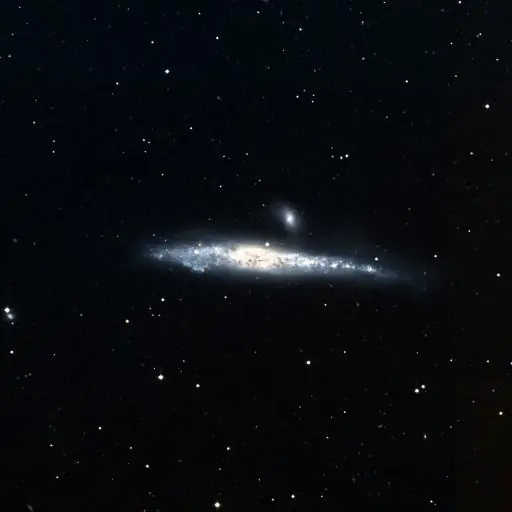
A whale-shaped galaxy blowing a hot wind out of its own disc, powered by countless exploding stars.
At the heart of the Whale Galaxy, stars are being born and dying at a furious pace. So many massive stars have exploded as supernovae in its central starburst that together they are blowing gas right out of the galaxy’s disc. This superwind has wrapped the whole galaxy in a giant corona of hot gas that glows in X-rays.
Because we see this barred spiral galaxy edge-on, professional astronomers use it to study the gas and stars that live outside a galaxy’s flat plane — exactly where that wind is blowing.
William Herschel discovered it on 20 March 1787. Its slightly bent, wedge-like outline reminds some people of a herring, but the name that stuck is the Whale.
Whale Galaxy (NGC 4631) is 24 million light-years away: the light we see from it set off about 24 million years ago, when the Himalayas and the Alps were rising.
Did you know?
- A record-breaking afterglow. In January 2021 the ATLAS survey caught a luminous red nova here, AT 2021biy — most likely from a pair of stars, the heavier 17 to 24 times the Sun’s mass. Its glow held on a plateau for 210 days, the longest yet seen.
- A peculiar pair. Its small companion, the dwarf elliptical NGC 4627, sits close by. Halton Arp listed the two in his Atlas of Peculiar Galaxies as an example of a double galaxy.
How big is it?
About as wide as our Milky Way. Light itself takes 100,000 years to cross it. Shrink it to the length of a football pitch and our whole Solar System would be smaller than a bacterium.
A large edge-on spiral shaped like a whale, with the small elliptical NGC 4627 just above it; bright and easy in medium telescopes.
When and where to see it
It is best placed in the evening sky around May, when it crosses the meridian at about 10 pm local time (around midnight in April). It can be seen from everywhere north of 57°S and never sets north of 57°N.
At its highest it stands 73° up from 50°N, 88° up from 35°N, 57° up from the equator, 22° up from 35°S.
Facts
- Type
- Galaxy
- Constellation
- Canes Venatici
- Designations
- NGC 4631, C 32
- Magnitude
- 9.2
- Apparent size
- 14′ × 2.2′
- Position
- RA 12h 42.1m, Dec +32° 33′ (J2000)
- Distance
- 24 million light-years
- Discovered
- William Herschel, 1787
Open AstroPilot to see when Whale Galaxy (NGC 4631) is highest tonight from your location, how easy it is with your telescope or binoculars, and an eyepiece view.