Coalsack Cluster (NGC 4609)
Coalsack Cluster (NGC 4609) is an open cluster in the constellation Crux, magnitude 6.9, 6.5′ across.
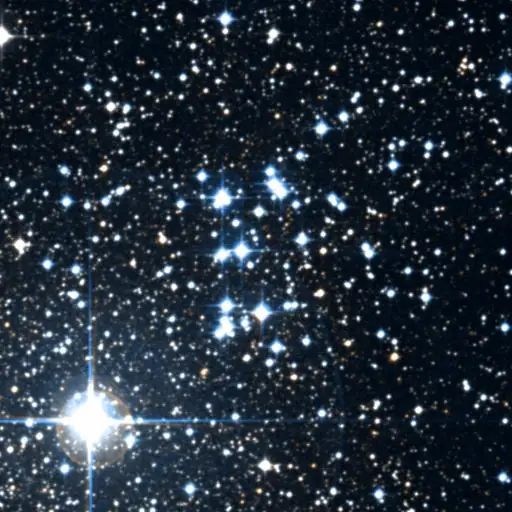
A cluster named after the Coalsack that actually lies far beyond it — born when dinosaurs still walked the Earth.
Despite its name, the Coalsack Cluster has nothing to do with the Coalsack. That famous dark cloud of dust lies in front; NGC 4609 sits far beyond it, and the two only line up by chance.
The cluster is about 83 million years old, so its stars were born while dinosaurs still walked the Earth — they would not die out for another 17 million years. It is a sparse open cluster: only 33 probable members have been identified, with just one red giant among them. Its stars are slightly richer in iron than the Sun.
The Scottish astronomer James Dunlop discovered it on 12 May 1826, while cataloguing the southern sky from New South Wales.
Coalsack Cluster (NGC 4609) is 4,600 light-years away: the light we see from it set off around 2580 BC, around the time the Great Pyramid of Giza was completed.
Did you know?
- A spinning member. One of its stars, BZ Crucis, is a variable Be star: a hot star rotating so rapidly that it throws off a disc of gas, which makes its light change.
- Head of the Emu. The Coalsack in front of the cluster is part of the Emu in the Sky, traced in dark dust clouds along the Milky Way by Aboriginal Australians — the Coalsack forms the emu’s head.
How big is it?
Born about 81 million years ago, when dinosaurs still walked the Earth. Light itself takes 8.7 years to cross it. Gaia has picked out 427 stars moving together through space as its members. That’s twice the distance from the Sun to the nearest star. Shrink our Solar System — the Sun and all eight planets — to the size of a coin, and the Coalsack Cluster would be 220 m across (2 football pitches end to end); the nearest star would be a football pitch away, and the Milky Way 2,520 km across.
A small open cluster seen against the dark Coalsack Nebula in Crux.
When and where to see it
It is best placed in the evening sky around May, when it crosses the meridian at about 10 pm local time (around midnight in April). It can be seen from everywhere south of 27°N and never sets south of 27°S.
At its highest it stands below the horizon from 50°N, below the horizon from 35°N, 27° up from the equator, 62° up from 35°S.
Facts
- Type
- Open cluster
- Constellation
- Crux
- Designations
- NGC 4609, C 98
- Magnitude
- 6.9
- Apparent size
- 6.5′
- Position
- RA 12h 42.3m, Dec −62° 60′ (J2000)
- Distance
- 4,600 light-years
- Discovered
- James Dunlop, 1826
Open AstroPilot to see when Coalsack Cluster (NGC 4609) is highest tonight from your location, how easy it is with your telescope or binoculars, and an eyepiece view.