Owl Cluster (NGC 457)
Owl Cluster (NGC 457) is an open cluster in the constellation Cassiopeia, magnitude 6.4, 20′ across.
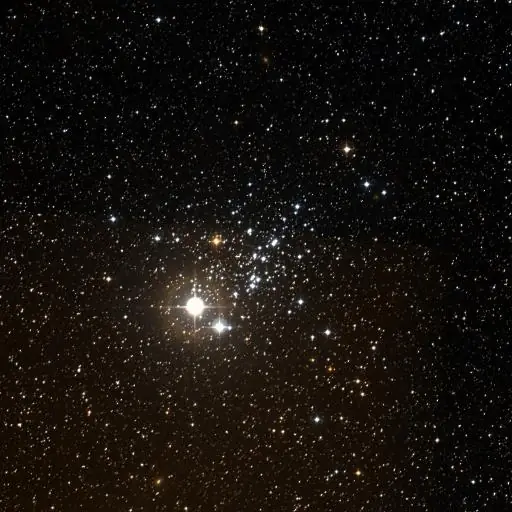
A young star cluster with many names — and an ‘eye’ that may be one of the most luminous stars known.
Few clusters have collected as many nicknames as NGC 457. Observers call it the Owl Cluster, the E.T. Cluster after the film’s friendly alien, the Dragonfly, the Kachina Doll and the Phi Cassiopeiae Cluster. William Herschel discovered it and catalogued it as VII 42.
This open cluster is young, about 21 million years old, and around 60 stars are known to be true members. The bright star Phi Cassiopeiae marks one of the ‘eyes’. Nobody is yet sure whether it belongs to the cluster. If it does, it would be one of the most luminous stars known, outshining even Rigel.
Owl Cluster (NGC 457) is 9,100 light-years away: the light we see from it set off around 7080 BC, 1,570 years before the first towns were growing in the Fertile Crescent.
Did you know?
- Our Sun at that distance. Placed beside Phi Cassiopeiae, the Sun would shine at only magnitude 17.3 — a target for large telescopes — while Phi Cassiopeiae itself can be seen with the naked eye.
- A red supergiant too. The cluster’s next brightest star is V466 Cassiopeiae, a red supergiant that changes in brightness.
How big is it?
Born about 21 million years ago, when the Himalayas and the Alps were rising. Light itself takes 53 years to cross it. Gaia has picked out 849 stars moving together through space as its members. That’s 12 times the distance from the Sun to the nearest star. Shrink our Solar System — the Sun and all eight planets — to the size of a coin, and the Owl Cluster would be 1.34 km across (a 15-minute walk); the nearest star would be a football pitch away, and the Milky Way 2,520 km across.
A bright open cluster nicknamed the Owl or E.T. Cluster: two bright stars, including Phi Cassiopeiae, make the eyes, and rows of fainter stars the outstretched arms.
When and where to see it
It is best placed in the evening sky around November, when it crosses the meridian at about 10 pm local time (around midnight in October). It can be seen from everywhere north of 32°S and never sets north of 32°N.
At its highest it stands 82° up from 50°N, 67° up from 35°N, 32° up from the equator, below the horizon from 35°S.
Facts
- Type
- Open cluster
- Constellation
- Cassiopeia
- Designations
- NGC 457, C 13, Mel 7, Cr 12, E.T. Cluster, Melotte 7, Collinder 12
- Magnitude
- 6.4
- Apparent size
- 20′
- Position
- RA 1h 19.5m, Dec +58° 17′ (J2000)
- Distance
- 9,100 light-years
- Discovered
- William Herschel
Open AstroPilot to see when Owl Cluster (NGC 457) is highest tonight from your location, how easy it is with your telescope or binoculars, and an eyepiece view.