Butterfly Galaxies (NGC 4567)
Butterfly Galaxies (NGC 4567) is a galaxy in the constellation Virgo, magnitude 11.3, 2.7′ × 2.1′ across.
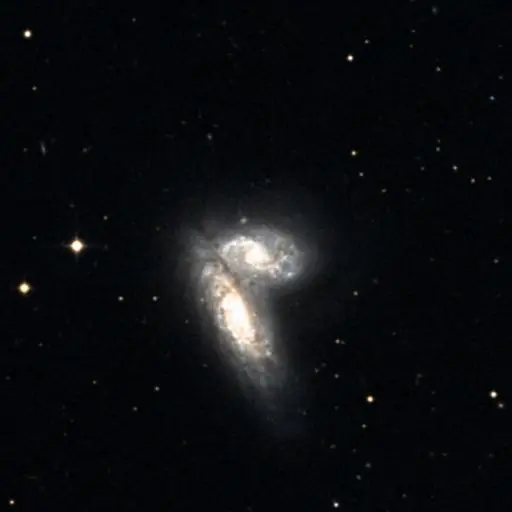
One wing of the Butterfly — a spiral in the first stages of a slow collision with its neighbour.
Two spiral galaxies overlap on the sky like a butterfly’s open wings: NGC 4567 is one, NGC 4568 the other. This is no chance alignment. Maps of their hydrogen gas show the pair are starting to collide, and stars are forming fastest where the two discs overlap. William Herschel discovered both in 1784. They belong to the Virgo Cluster.
Butterfly Galaxies (NGC 4567) is 55 million light-years away: the light we see from it set off about 55 million years ago, when mammals were taking over a world without dinosaurs.
Did you know?
- A retired nickname. The pair were long called the Siamese Twins because they look joined. In August 2020 NASA said it would stop using that name, as part of an effort to avoid discriminatory terms.
How big is it?
44% of the Milky Way’s width. Light itself takes 44,000 years to cross it. Shrink it to the length of a football pitch and our whole Solar System would be about the size of a red blood cell.
An 11.3-magnitude spiral galaxy (Sbc) in Virgo, about 2.7′ × 2.2′.
When and where to see it
It is best placed in the evening sky around May, when it crosses the meridian at about 10 pm local time (around midnight in March). It can be seen from everywhere north of 79°S and never sets north of 79°N.
At its highest it stands 51° up from 50°N, 66° up from 35°N, 79° up from the equator, 44° up from 35°S.
Facts
- Type
- Galaxy
- Constellation
- Virgo
- Designations
- NGC 4567, Butterfly Galaxies, Siamese Twins
- Magnitude
- 11.3
- Apparent size
- 2.7′ × 2.1′
- Position
- RA 12h 36.5m, Dec +11° 15′ (J2000)
- Distance
- 55 million light-years
- Discovered
- William Herschel, 1784
Open AstroPilot to see when Butterfly Galaxies (NGC 4567) is highest tonight from your location, how easy it is with your telescope or binoculars, and an eyepiece view.