Needle Galaxy (NGC 4565)
Needle Galaxy (NGC 4565) is a galaxy in the constellation Coma Berenices, magnitude 10.1 (blue), 17′ × 2.9′ across.
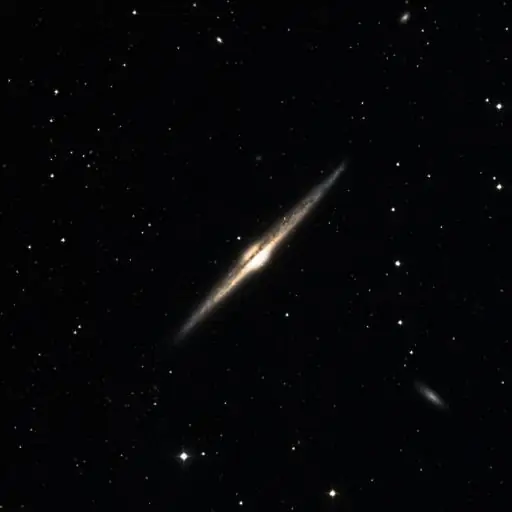
A giant spiral brighter than Andromeda, seen perfectly side-on — with a bar hidden in its middle.
More luminous than even the Andromeda Galaxy, NGC 4565 is a giant spiral galaxy that we happen to see exactly edge-on. That view hides its shape, so its centre long puzzled astronomers. Infrared studies with the Spitzer Space Telescope settled the question: NGC 4565 has a central bar, as the Milky Way does, with a pseudobulge inside it and an inner ring.
Its disc is gently warped, probably by tugs from its satellite galaxies. Radio maps made with LOFAR found a faint halo whose shape follows the warp, which is at least 130 million years old, and a bridge of hydrogen gas joining it to the small galaxy IC 3571 shows the two met recently in cosmic terms.
William Herschel discovered it on 6 April 1785.
Needle Galaxy (NGC 4565) is 39 million light-years away: the light we see from it set off about 39 million years ago, when the Himalayas and the Alps were rising.
Did you know?
- More clusters than ours. About 240 globular clusters orbit NGC 4565 — more than the Milky Way has.
- Berenice’s Hair Clip. Besides the Needle, it is called the Flying Saucer and Berenice’s Hair Clip, after its constellation, Coma Berenices — the hair of Queen Berenice.
- Looking out of our galaxy. It lies close to the North Galactic Pole, so we see it by looking straight out of the Milky Way’s disc, through very little of our own galaxy’s dust.
How big is it?
1.9 times as wide as our Milky Way. Light itself takes 190,000 years to cross it. Shrink it to the length of a football pitch and our whole Solar System would be smaller than a bacterium.
The finest edge-on spiral in the northern sky: a long, thin needle of light with a bright central bulge split by a dark dust lane.
When and where to see it
It is best placed in the evening sky around May, when it crosses the meridian at about 10 pm local time (around midnight in March). It can be seen from everywhere north of 64°S and never sets north of 64°N.
At its highest it stands 66° up from 50°N, 81° up from 35°N, 64° up from the equator, 29° up from 35°S.
Facts
- Type
- Galaxy
- Constellation
- Coma Berenices
- Designations
- NGC 4565, C 38
- Magnitude
- 10.1 (blue)
- Apparent size
- 17′ × 2.9′
- Position
- RA 12h 36.3m, Dec +25° 59′ (J2000)
- Distance
- 39 million light-years
- Discovered
- William Herschel, 1785
Open AstroPilot to see when Needle Galaxy (NGC 4565) is highest tonight from your location, how easy it is with your telescope or binoculars, and an eyepiece view.