NGC 4559 (C 36)
NGC 4559 (C 36) is a galaxy in the constellation Coma Berenices, magnitude 9.9, 11′ × 4.8′ across.
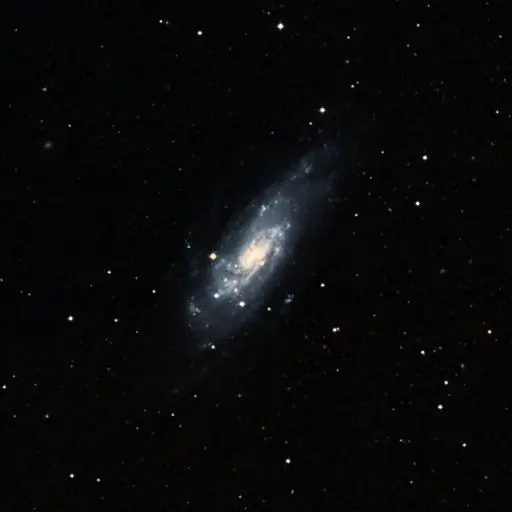
Home to a restless giant star that has erupted almost every year since 2016 — and survived each time.
A restless star in NGC 4559 keeps crying wolf. AT 2016blu, a luminous blue variable, was caught erupting in 2012, again in 2014, and then almost every year from 2016 to 2026. Each outburst looks like a supernova, yet the star survives.
Luminous blue variables are among the heaviest and most unstable stars known; Eta Carinae, in the Carina Nebula, is the most famous.
William Herschel discovered this spiral galaxy on 11 April 1785. It belongs to the Coma I group of galaxies.
NGC 4559 (C 36) is 29 million light-years away: the light we see from it set off about 29 million years ago, when the Himalayas and the Alps were rising.
Did you know?
- Rebecca Jones’s supernova. Rebecca Jones discovered SN 1941A here on 24 February 1941. Older photographs showed it had already been visible since 5 February.
- Neither barred nor unbarred. NGC 4559 is an intermediate spiral, halfway between barred and unbarred, with a weak inner ring around its centre.
How big is it?
About as wide as our Milky Way. Light itself takes 89,000 years to cross it. Shrink it to the length of a football pitch and our whole Solar System would be smaller than a bacterium.
A large, inclined spiral in Coma Berenices, showing a mottled, elongated glow.
When and where to see it
It is best placed in the evening sky around May, when it crosses the meridian at about 10 pm local time (around midnight in March). It can be seen from everywhere north of 62°S and never sets north of 62°N.
At its highest it stands 68° up from 50°N, 83° up from 35°N, 62° up from the equator, 27° up from 35°S.
Facts
- Type
- Galaxy
- Constellation
- Coma Berenices
- Designations
- C 36
- Magnitude
- 9.9
- Apparent size
- 11′ × 4.8′
- Position
- RA 12h 36.0m, Dec +27° 58′ (J2000)
- Distance
- 29 million light-years
- Discovered
- William Herschel, 1785
Open AstroPilot to see when NGC 4559 (C 36) is highest tonight from your location, how easy it is with your telescope or binoculars, and an eyepiece view.