NGC 4536
NGC 4536 is a galaxy in the constellation Virgo, magnitude 10.5, 7.1′ × 2.5′ across.
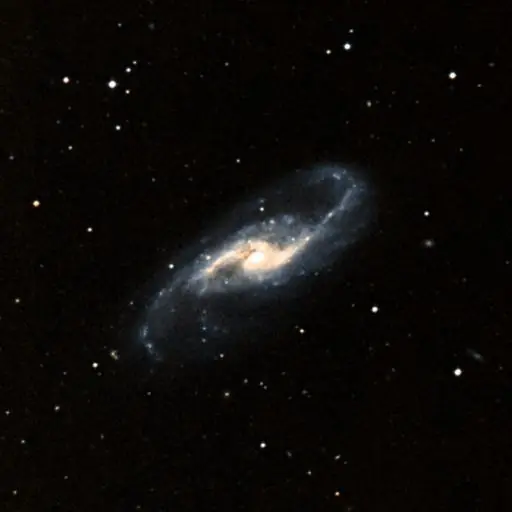
A barred spiral with a ring of star birth at its heart, and a supernova that reached 12th magnitude.
A ring of intense star birth circles the bar at the heart of NGC 4536, marking it as an HII galaxy — one in the middle of a strong burst of star formation. It has no classical bulge, and X-rays from its core hint at a modest black hole of perhaps ten thousand to a million Suns. William Herschel discovered it on 24 January 1784. Though it lies about 10° south of the Virgo Cluster’s centre, it belongs instead to the M 61 Group.
NGC 4536 is 48 million light-years away: the light we see from it set off about 48 million years ago, when mammals were taking over a world without dinosaurs.
Did you know?
- Supernova 1981B. Dmitry Tsvetkov found a Type Ia supernova here on 2 March 1981. It peaked at magnitude 12 six days later, then faded from view over the next two months.
How big is it?
About as wide as our Milky Way. Light itself takes 99,000 years to cross it. Shrink it to the length of a football pitch and our whole Solar System would be smaller than a bacterium.
A 10.5-magnitude weakly barred spiral galaxy (SABb) in Virgo, about 7.1′ × 2.6′.
When and where to see it
It is best placed in the evening sky around May, when it crosses the meridian at about 10 pm local time (around midnight in March). It can be seen from everywhere north of 88°S and never sets north of 88°N.
At its highest it stands 42° up from 50°N, 57° up from 35°N, 88° up from the equator, 53° up from 35°S.
Facts
- Type
- Galaxy
- Constellation
- Virgo
- Designations
- NGC 4536
- Magnitude
- 10.5
- Apparent size
- 7.1′ × 2.5′
- Position
- RA 12h 34.5m, Dec +2° 11′ (J2000)
- Distance
- 48 million light-years
- Discovered
- William Herschel, 1784
Open AstroPilot to see when NGC 4536 is highest tonight from your location, how easy it is with your telescope or binoculars, and an eyepiece view.