NGC 4535
NGC 4535 is a galaxy in the constellation Virgo, magnitude 9.9, 8.2′ × 7.5′ across.
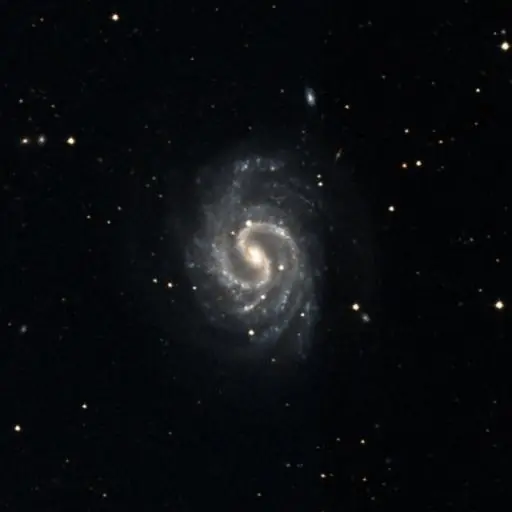
Faint enough to be called “the Lost Galaxy”, yet Hubble used its pulsing stars to measure its distance.
Its light is spread so thinly that NGC 4535 has been nicknamed “the Lost Galaxy”: low surface brightness lets it fade into the sky. Yet it is a handsome barred spiral, whose two inner arms branch into many as they wind outwards. William Herschel found it on 28 December 1785. It belongs to the Virgo Cluster.
In 1999 the Hubble Space Telescope picked out Cepheids here — variable stars whose rhythm of brightening and fading reveals their true power. They gave a distance that matched other members of the cluster.
NGC 4535 is 51 million light-years away: the light we see from it set off about 51 million years ago, when mammals were taking over a world without dinosaurs.
Did you know?
- A pair that isn’t. Erik Holmberg listed it in 1937 as a double with NGC 4535A. The companion is actually about seven times farther away — the two only line up by chance.
How big is it?
1.2 times as wide as our Milky Way. Light itself takes 120,000 years to cross it. Shrink it to the length of a football pitch and our whole Solar System would be smaller than a bacterium.
A 9.9-magnitude spiral galaxy (Sc) in Virgo, about 8.2′ × 7.5′.
When and where to see it
It is best placed in the evening sky around May, when it crosses the meridian at about 10 pm local time (around midnight in March). It can be seen from everywhere north of 82°S and never sets north of 82°N.
At its highest it stands 48° up from 50°N, 63° up from 35°N, 82° up from the equator, 47° up from 35°S.
Facts
- Type
- Galaxy
- Constellation
- Virgo
- Designations
- NGC 4535
- Magnitude
- 9.9
- Apparent size
- 8.2′ × 7.5′
- Position
- RA 12h 34.3m, Dec +8° 12′ (J2000)
- Distance
- 51 million light-years
- Discovered
- William Herschel, 1785
Open AstroPilot to see when NGC 4535 is highest tonight from your location, how easy it is with your telescope or binoculars, and an eyepiece view.