NGC 4527
NGC 4527 is a galaxy in the constellation Virgo, magnitude 10.5, 6.3′ × 1.7′ across.
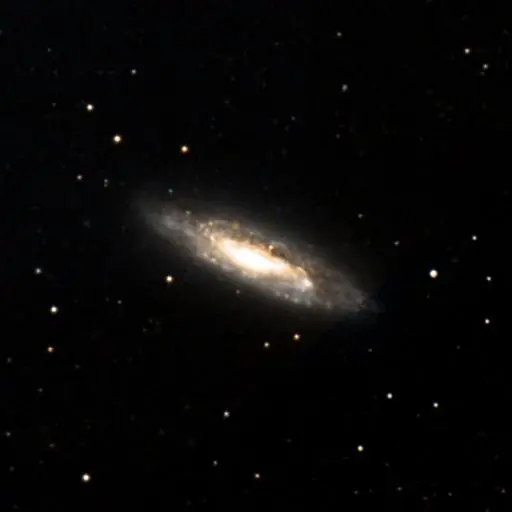
Host of Supernova 1991T, the overbright explosion that became the template for a whole class.
Deep in its centre, NGC 4527 hoards about 2.5 billion Suns’ worth of molecular hydrogen — the raw material of new stars. A burst of star formation has begun there, though it still seems to be in its earliest, gentle phase. William Herschel discovered this spiral galaxy on 23 February 1784. It belongs to the M 61 Group, on the outskirts of the Virgo Cluster.
NGC 4527 is 41 million light-years away: the light we see from it set off about 41 million years ago, when mammals were taking over a world without dinosaurs.
Did you know?
- Supernova 1991T. Found by Stephen Knight on 13 April 1991, this white-dwarf explosion was brighter and stranger than a normal Type Ia. It has been studied so closely that similar events are now called “91T-like”.
- Heber Curtis’s supernova. The first supernova seen here, in 1915, was found by Heber Curtis — who five years later argued in the Great Debate that spiral nebulae are galaxies like our own.
How big is it?
75% of the Milky Way’s width. Light itself takes 75,000 years to cross it. Shrink it to the length of a football pitch and our whole Solar System would be smaller than a bacterium.
A 10.5-magnitude weakly barred spiral galaxy (SABb) in Virgo, about 6.3′ × 1.7′.
When and where to see it
It is best placed in the evening sky around May, when it crosses the meridian at about 10 pm local time (around midnight in March). It can be seen from everywhere north of 87°S and never sets north of 87°N.
At its highest it stands 43° up from 50°N, 58° up from 35°N, 87° up from the equator, 52° up from 35°S.
Facts
- Type
- Galaxy
- Constellation
- Virgo
- Designations
- NGC 4527
- Magnitude
- 10.5
- Apparent size
- 6.3′ × 1.7′
- Position
- RA 12h 34.1m, Dec +2° 39′ (J2000)
- Distance
- 41 million light-years
- Discovered
- William Herschel, 1784
Open AstroPilot to see when NGC 4527 is highest tonight from your location, how easy it is with your telescope or binoculars, and an eyepiece view.