NGC 4526 (NGC 4560)
NGC 4526 (NGC 4560) is a galaxy in the constellation Virgo, magnitude 9.6, 9.6′ × 3.3′ across.
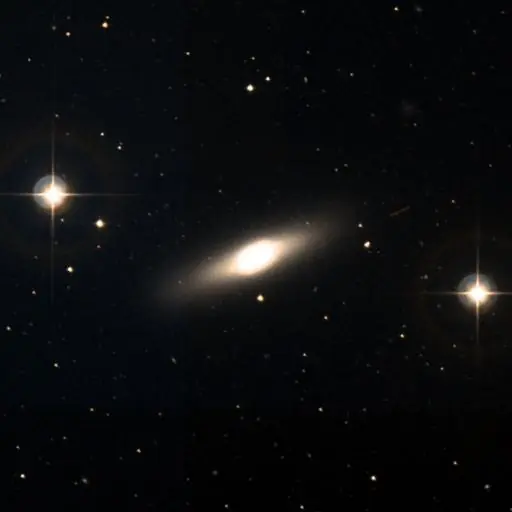
A dusty Virgo galaxy whose black hole was the first weighed by tracking the swirl of its molecular gas.
Lenticular galaxies sit between spirals and ellipticals: a disc and a bright bulge, but no real spiral arms. NGC 4526 is one of the brightest known, seen nearly edge-on with a dark band of dust across its middle. It lies in the Virgo Cluster.
William Herschel found it on 13 April 1784, then observed it again in December 1785 — and so it entered the New General Catalogue twice, also as NGC 4560.
NGC 4526 (NGC 4560) is 55 million light-years away: the light we see from it set off about 55 million years ago, when mammals were taking over a world without dinosaurs.
Did you know?
- A black hole weighed by its gas. Its core hides a black hole of roughly 450 million Suns. It was the first black hole weighed by measuring how molecular gas rotates around it with a radio interferometer — the CARMA array in California.
- Supernova 1994D. In March 1994 a carbon–oxygen white dwarf exploded here. It was caught about two weeks before peak brightness, and Hubble’s picture of it — a bright point beside the dusty disc — became a classic.
- Light on dark matter. The orbits of globular clusters in its outer halo suggest unusually little dark matter: less than half the mass out there seems to be the invisible kind.
How big is it?
1.5 times as wide as our Milky Way. Light itself takes 150,000 years to cross it. Shrink it to the length of a football pitch and our whole Solar System would be smaller than a bacterium.
A 9.6-magnitude lenticular galaxy (S0) in Virgo, about 9.6′ × 3.3′.
When and where to see it
It is best placed in the evening sky around May, when it crosses the meridian at about 10 pm local time (around midnight in March). It can be seen from everywhere north of 82°S and never sets north of 82°N.
At its highest it stands 48° up from 50°N, 63° up from 35°N, 82° up from the equator, 47° up from 35°S.
Facts
- Type
- Galaxy
- Constellation
- Virgo
- Designations
- NGC 4560
- Magnitude
- 9.6
- Apparent size
- 9.6′ × 3.3′
- Position
- RA 12h 34.1m, Dec +7° 42′ (J2000)
- Distance
- 55 million light-years
- Discovered
- William Herschel, 1784, Seen again in 1785 and catalogued a second time as NGC 4560
Open AstroPilot to see when NGC 4526 (NGC 4560) is highest tonight from your location, how easy it is with your telescope or binoculars, and an eyepiece view.