NGC 45
NGC 45 is a galaxy in the constellation Cetus, magnitude 10.4, 6.2′ × 4.4′ across.
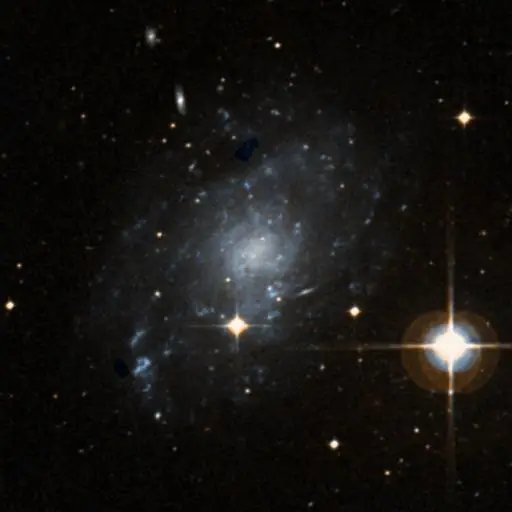
A shy spiral with no bulge to speak of — and the scene of a possible stellar merger in 2018.
Most spiral galaxies have a bright central hub. NGC 45 barely has one at all. It is a loose, dim spiral galaxy with no clearly defined arms, its light spread so thinly that astronomers class it as a galaxy of low surface brightness. New stars form here only slowly. It shares its patch of sky with the Sculptor Group of galaxies but most likely lies well behind it. John Herschel discovered it on 11 November 1835.
NGC 45 is 22 million light-years away: the light we see from it set off about 22 million years ago, when the Himalayas and the Alps were rising.
Did you know?
- Two stars become one?. In 2018 a survey caught a “luminous red nova” here, AT 2018bwo. Such outbursts are thought to happen when two stars merge. Before the flare, the star at that spot was a yellow supergiant.
How big is it?
40% of the Milky Way’s width. Light itself takes 40,000 years to cross it. Shrink it to the length of a football pitch and our whole Solar System would be about the size of a red blood cell.
A 10.4-magnitude weakly barred spiral galaxy (SABd) in Cetus, about 6.2′ × 4.4′.
When and where to see it
It is best placed in the evening sky around October, when it crosses the meridian at about 10 pm local time (around midnight in September). It can be seen from everywhere south of 67°N and never sets south of 67°S.
At its highest it stands 17° up from 50°N, 32° up from 35°N, 67° up from the equator, 78° up from 35°S.
Facts
- Type
- Galaxy
- Constellation
- Cetus
- Designations
- NGC 45
- Magnitude
- 10.4
- Apparent size
- 6.2′ × 4.4′
- Position
- RA 0h 14.1m, Dec −23° 11′ (J2000)
- Distance
- 22 million light-years
- Discovered
- John Herschel, 1835
Open AstroPilot to see when NGC 45 is highest tonight from your location, how easy it is with your telescope or binoculars, and an eyepiece view.