Cocoon Galaxy (NGC 4490)
Cocoon Galaxy (NGC 4490) is a galaxy in the constellation Canes Venatici, magnitude 9.7, 6.7′ × 1.6′ across.
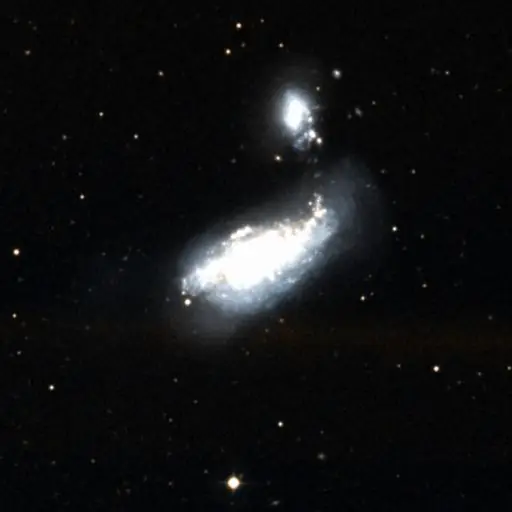
The Cocoon Galaxy and its small partner, rushing apart after a close encounter.
NGC 4490 and its small companion, NGC 4485, have already had their closest brush and are now rushing apart. The encounter has set NGC 4490 ablaze with new stars, and a stream of stars and gas still links the pair, dotted with knots where hot blue stars are forming. It is one of the closest interacting pairs of galaxies to us, and even has a double nucleus. Halton Arp listed the two together as Arp 269.
William Herschel found NGC 4490, the Cocoon Galaxy, on 14 January 1788.
Cocoon Galaxy (NGC 4490) is 22 million light-years away: the light we see from it set off about 22 million years ago, when the Himalayas and the Alps were rising.
Did you know?
- Two stars merge. In August 2011 Giancarlo Cortini and Stefano Antonellini found a luminous red nova here, AT 2011kp — the outburst thought to mark two stars spiralling together and merging.
How big is it?
43% of the Milky Way’s width. Light itself takes 43,000 years to cross it. Shrink it to the length of a football pitch and our whole Solar System would be about the size of a red blood cell.
A 9.7-magnitude barred spiral galaxy (SBcd) in Canes Venatici, about 6.7′ × 1.7′.
When and where to see it
It is best placed in the evening sky around April, when it crosses the meridian at about 10 pm local time (around midnight in March). It can be seen from everywhere north of 48°S and never sets north of 48°N.
At its highest it stands 82° up from 50°N, 83° up from 35°N, 48° up from the equator, 13° up from 35°S.
Facts
- Type
- Galaxy
- Constellation
- Canes Venatici
- Designations
- NGC 4490
- Magnitude
- 9.7
- Apparent size
- 6.7′ × 1.6′
- Position
- RA 12h 30.6m, Dec +41° 39′ (J2000)
- Distance
- 22 million light-years
- Discovered
- William Herschel, 1788
Open AstroPilot to see when Cocoon Galaxy (NGC 4490) is highest tonight from your location, how easy it is with your telescope or binoculars, and an eyepiece view.