NGC 4449 (C 21)
NGC 4449 (C 21) is a galaxy in the constellation Canes Venatici, magnitude 9.6, 4.7′ × 2.7′ across.
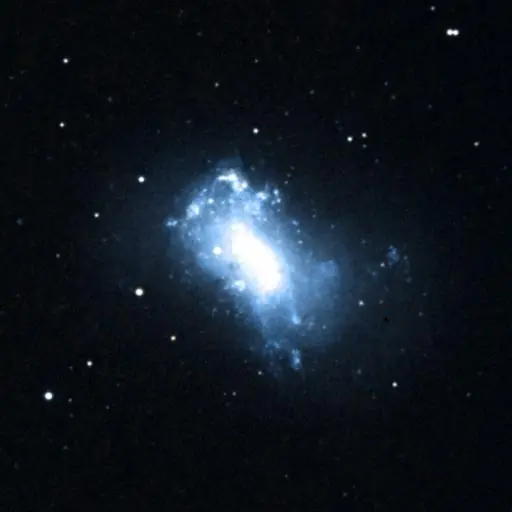
A Large Magellanic Cloud in overdrive — making stars at twice the pace while it swallows two smaller galaxies.
Imagine the Large Magellanic Cloud in overdrive. NGC 4449 has the same loose, barred shape as our neighbour, but it is making stars twice as fast. Photographs show it splashed with the pink glow of hydrogen, the tell-tale sign of massive young stars, and studded with young clusters — one of them right at its centre.
Encounters with other galaxies have probably stoked that fire, and they are still going on. In 2012 astronomers found two small galaxies being torn apart and absorbed by NGC 4449: a faint, shredded dwarf rich in dark matter, and a flattened clump of stars trailing two tails of young stars that may be the core of a gas-rich galaxy.
William Herschel discovered it on 27 April 1788.
NGC 4449 (C 21) is 13 million light-years away: the light we see from it set off about 13 million years ago, when great apes were spreading through Africa and Europe.
Did you know?
- A vast hidden cloud. Around NGC 4449 lies an envelope of hydrogen gas about 14 times wider than the visible galaxy, twisted and distorted by encounters with its neighbours.
- An X-ray powerhouse. It hosts an ultraluminous X-ray source, NGC 4449 X7. Three supergiant stars, each about eight times the Sun’s mass, are candidates for its visible counterpart.
How big is it?
18% of the Milky Way’s width. Light itself takes 18,000 years to cross it. Shrink it to the length of a football pitch and our whole Solar System would be about the size of a red blood cell.
An irregular starburst galaxy in Canes Venatici, appearing as a bright, rectangular glow.
When and where to see it
It is best placed in the evening sky around April, when it crosses the meridian at about 10 pm local time (around midnight in March). It can be seen from everywhere north of 46°S and never sets north of 46°N.
At its highest it stands 84° up from 50°N, 81° up from 35°N, 46° up from the equator, 11° up from 35°S.
Facts
- Type
- Galaxy
- Constellation
- Canes Venatici
- Designations
- C 21
- Magnitude
- 9.6
- Apparent size
- 4.7′ × 2.7′
- Position
- RA 12h 28.2m, Dec +44° 6′ (J2000)
- Distance
- 13 million light-years
- Discovered
- William Herschel, 1788
Open AstroPilot to see when NGC 4449 (C 21) is highest tonight from your location, how easy it is with your telescope or binoculars, and an eyepiece view.