NGC 4429
NGC 4429 is a galaxy in the constellation Virgo, magnitude 10.1, 5.3′ × 2.4′ across.
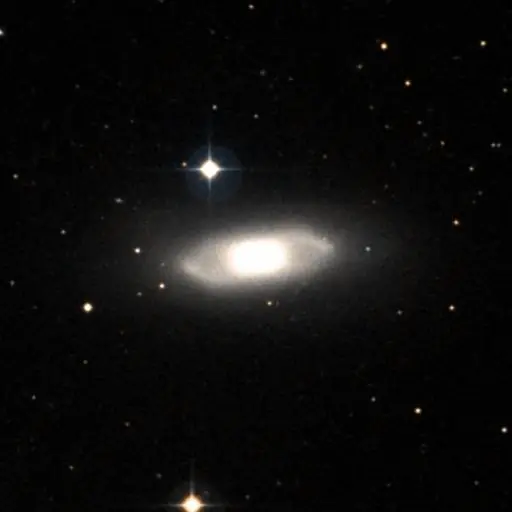
A galaxy with a hexagonal bulge, slowly losing its gas to the Virgo Cluster.
Galaxies are not supposed to have corners, but the bright central bulge of NGC 4429 is hexagonal. Inside it lie a small disc of dust and possibly a cold disc of stars, perhaps built from gas that fell inwards after a merger long ago — so long ago that no sign of disturbance remains. Seen almost edge-on, this lenticular galaxy may now be losing much of its gas, swept away as it moves through the hot gas of the Virgo Cluster.
William Herschel found it on 15 March 1784.
NGC 4429 is 53 million light-years away: the light we see from it set off about 53 million years ago, when mammals were taking over a world without dinosaurs.
How big is it?
82% of the Milky Way’s width. Light itself takes 82,000 years to cross it. Shrink it to the length of a football pitch and our whole Solar System would be smaller than a bacterium.
A 10.1-magnitude lenticular galaxy (S0-a) in Virgo, about 5.3′ × 2.4′.
When and where to see it
It is best placed in the evening sky around April, when it crosses the meridian at about 10 pm local time (around midnight in March). It can be seen from everywhere north of 79°S and never sets north of 79°N.
At its highest it stands 51° up from 50°N, 66° up from 35°N, 79° up from the equator, 44° up from 35°S.
Facts
- Type
- Galaxy
- Constellation
- Virgo
- Designations
- NGC 4429
- Magnitude
- 10.1
- Apparent size
- 5.3′ × 2.4′
- Position
- RA 12h 27.4m, Dec +11° 6′ (J2000)
- Distance
- 53 million light-years
- Discovered
- William Herschel, 1784
Open AstroPilot to see when NGC 4429 is highest tonight from your location, how easy it is with your telescope or binoculars, and an eyepiece view.