NGC 4414
NGC 4414 is a galaxy in the constellation Coma Berenices, magnitude 10.2, 1.9′ × 1.1′ across.
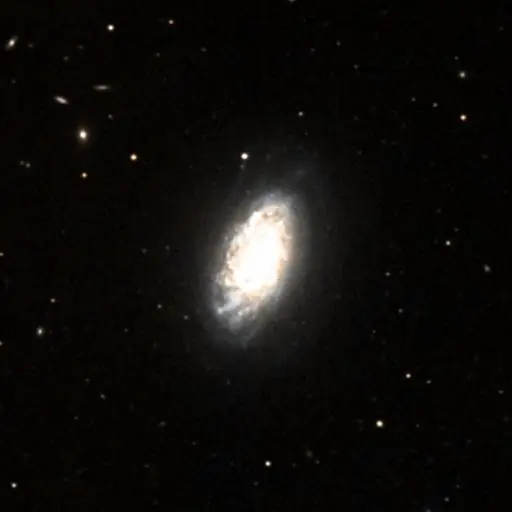
A fleecy, dusty spiral that posed for Hubble twice.
Hubble photographed NGC 4414 in 1995 to measure its distance from its Cepheid variable stars, and returned in 1999 to make a full-colour portrait for the Hubble Heritage project. The picture shows a flocculent spiral galaxy: no grand arms, just short, fleecy segments, dusty and laced with young blue stars. It has no sign of past run-ins with other galaxies, yet it is rich in gas, with hydrogen reaching far beyond its visible disc.
William Herschel found it on 13 March 1785.
NGC 4414 is 56 million light-years away: the light we see from it set off about 56 million years ago, when mammals were taking over a world without dinosaurs.
Did you know?
- A New Year’s Day supernova. On 1 January 2021 a Type Ia supernova, SN 2021J, was spotted here by the ALeRCE alert system. It was a bright one, at around magnitude 12.
How big is it?
32% of the Milky Way’s width. Light itself takes 32,000 years to cross it. Shrink it to the length of a football pitch and our whole Solar System would be about the size of a red blood cell.
A 10.2-magnitude spiral galaxy (Sc) in Coma Berenices, about 2′ × 1.1′.
When and where to see it
It is best placed in the evening sky around April, when it crosses the meridian at about 10 pm local time (around midnight in March). It can be seen from everywhere north of 59°S and never sets north of 59°N.
At its highest it stands 71° up from 50°N, 86° up from 35°N, 59° up from the equator, 24° up from 35°S.
Facts
- Type
- Galaxy
- Constellation
- Coma Berenices
- Designations
- NGC 4414
- Magnitude
- 10.2
- Apparent size
- 1.9′ × 1.1′
- Position
- RA 12h 26.5m, Dec +31° 13′ (J2000)
- Distance
- 56 million light-years
- Discovered
- William Herschel, 1785
Open AstroPilot to see when NGC 4414 is highest tonight from your location, how easy it is with your telescope or binoculars, and an eyepiece view.