NGC 4395
NGC 4395 is a galaxy in the constellation Canes Venatici, magnitude 10.3, 4.2′ × 1.4′ across.
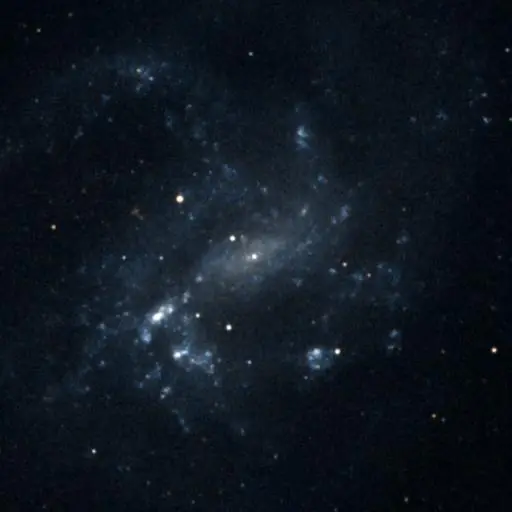
A faint dwarf spiral hiding one of the smallest black holes ever measured in a galaxy’s heart.
Active galaxies are usually powered by black holes of millions or billions of suns. The one in NGC 4395 may weigh only a few thousand to a few hundred thousand, among the smallest ever measured at a galaxy’s centre — perhaps a rare intermediate-mass black hole. It lives in an unlikely home: a faint dwarf spiral galaxy with no central bulge at all, and one of the nearest and least luminous Seyfert galaxies known.
William Herschel found it on 2 January 1786.
NGC 4395 is 15 million light-years away: the light we see from it set off about 15 million years ago, when great apes were spreading through Africa and Europe.
Did you know?
- Three patches, three numbers. Three brighter patches in the galaxy were catalogued as objects of their own: NGC 4399, NGC 4400 and NGC 4401.
- Measuring the universe. In 1974 Allan Sandage and Gustav Tammann used individual stars resolved in NGC 4395 and other nearby galaxies to measure how fast the universe is expanding.
How big is it?
18% of the Milky Way’s width. Light itself takes 18,000 years to cross it. Shrink it to the length of a football pitch and our whole Solar System would be about the size of a red blood cell.
A 10.3-magnitude Magellanic spiral galaxy (Sm) in Canes Venatici, about 4.2′ × 1.4′.
When and where to see it
It is best placed in the evening sky around April, when it crosses the meridian at about 10 pm local time (around midnight in March). It can be seen from everywhere north of 56°S and never sets north of 56°N.
At its highest it stands 74° up from 50°N, 89° up from 35°N, 56° up from the equator, 21° up from 35°S.
Facts
- Type
- Galaxy
- Constellation
- Canes Venatici
- Designations
- NGC 4395
- Magnitude
- 10.3
- Apparent size
- 4.2′ × 1.4′
- Position
- RA 12h 25.8m, Dec +33° 33′ (J2000)
- Distance
- 15 million light-years
- Discovered
- William Herschel, 1786
Open AstroPilot to see when NGC 4395 is highest tonight from your location, how easy it is with your telescope or binoculars, and an eyepiece view.