NGC 436 (Mel 6)
NGC 436 (Mel 6) is an open cluster in the constellation Cassiopeia, magnitude 8.8, 5.7′ across.
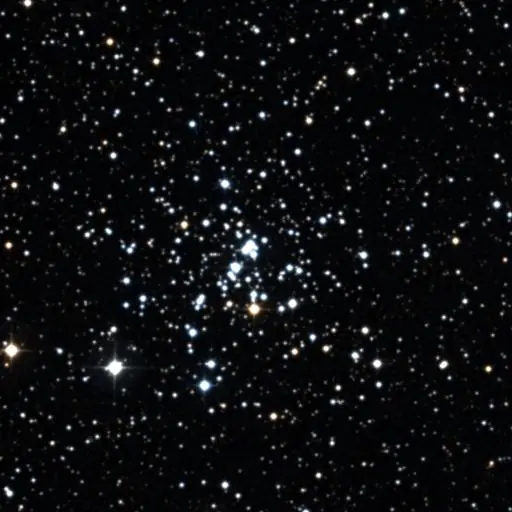
A small, compact cluster sitting in the shadow of a brighter neighbour, NGC 457.
William Herschel found NGC 436 on 3 November 1787, one of the many star clusters he swept up in the Milky Way band through Cassiopeia. A century later John Dreyer’s New General Catalogue summed it up as a small, irregular, fairly compressed cluster. It is an open cluster, a family of stars born together, and sits less than a degree from the much brighter NGC 457.
NGC 436 (Mel 6) is 10,000 light-years away: the light we see from it set off around 7980 BC, 1,530 years after the stone pillars of Göbekli Tepe, the oldest known temple, were raised.
How big is it?
Born about 56 million years ago, when mammals were taking over a world without dinosaurs. Light itself takes 17 years to cross it. Gaia has picked out 301 stars moving together through space as its members. That’s 3.9 times the distance from the Sun to the nearest star. Shrink our Solar System — the Sun and all eight planets — to the size of a coin, and NGC 436 would be 418 m across (4 football pitches end to end); the nearest star would be a football pitch away, and the Milky Way 2,520 km across.
An 8.8-magnitude open cluster in Cassiopeia, about 5.7′ across.
When and where to see it
It is best placed in the evening sky around November, when it crosses the meridian at about 10 pm local time (around midnight in October). It can be seen from everywhere north of 31°S and never sets north of 31°N.
At its highest it stands 81° up from 50°N, 66° up from 35°N, 31° up from the equator, below the horizon from 35°S.
Facts
- Type
- Open cluster
- Constellation
- Cassiopeia
- Designations
- Mel 6, Melotte 6
- Magnitude
- 8.8
- Apparent size
- 5.7′
- Position
- RA 1h 16.0m, Dec +58° 49′ (J2000)
- Distance
- 10,000 light-years
- Discovered
- William Herschel, 1787
Open AstroPilot to see when NGC 436 (Mel 6) is highest tonight from your location, how easy it is with your telescope or binoculars, and an eyepiece view.