NGC 4293
NGC 4293 is a galaxy in the constellation Coma Berenices, magnitude 10.2, 6.2′ × 3.7′ across.
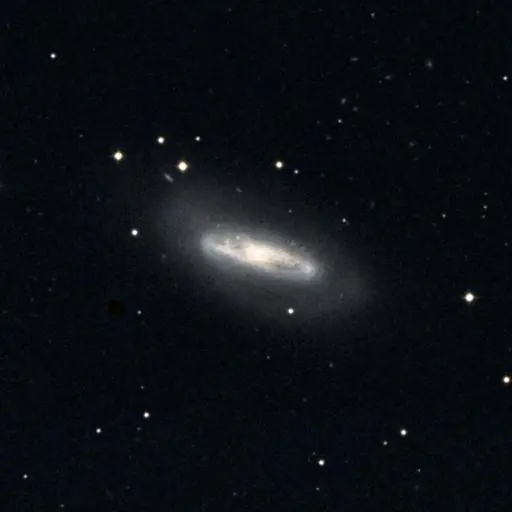
A ruffled Virgo Cluster galaxy whose starbirth has shrunk to its very centre.
The outskirts of NGC 4293 look ruffled. Its outer disc of stars is disturbed, a sign that something has tugged at it, and new stars now form only in a small region at its very centre. A member of the Virgo Cluster, this galaxy sits on the border between lenticular and spiral, with a bar and faint, tightly wound arms. At its heart a black hole of about 60 million suns feeds slowly, giving off a dim glow.
William Herschel, who found it on 14 March 1784, described it as “large, extended, resolvable”.
NGC 4293 is 55 million light-years away: the light we see from it set off about 55 million years ago, when mammals were taking over a world without dinosaurs.
How big is it?
About as wide as our Milky Way. Light itself takes 100,000 years to cross it. Shrink it to the length of a football pitch and our whole Solar System would be smaller than a bacterium.
A 10.2-magnitude lenticular galaxy (S0-a) in Coma Berenices, about 6.2′ × 3.7′.
When and where to see it
It is best placed in the evening sky around April, when it crosses the meridian at about 10 pm local time (around midnight in March). It can be seen from everywhere north of 72°S and never sets north of 72°N.
At its highest it stands 58° up from 50°N, 73° up from 35°N, 72° up from the equator, 37° up from 35°S.
Facts
- Type
- Galaxy
- Constellation
- Coma Berenices
- Designations
- NGC 4293
- Magnitude
- 10.2
- Apparent size
- 6.2′ × 3.7′
- Position
- RA 12h 21.2m, Dec +18° 23′ (J2000)
- Distance
- 55 million light-years
- Discovered
- William Herschel, 1784
Open AstroPilot to see when NGC 4293 is highest tonight from your location, how easy it is with your telescope or binoculars, and an eyepiece view.