NGC 4244 (C 26)
NGC 4244 (C 26) is a galaxy in the constellation Canes Venatici, magnitude 10.2, 16′ × 7.2′ across.
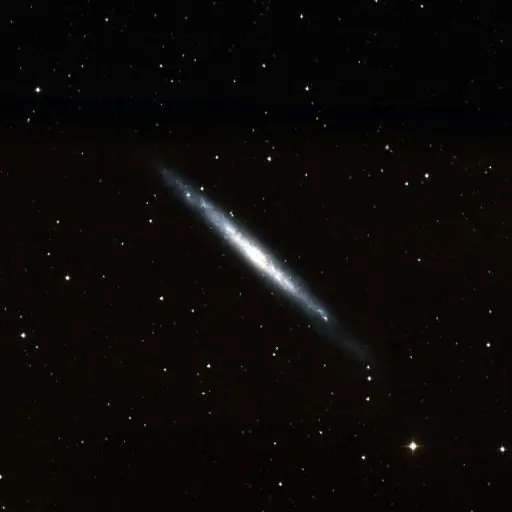
A spiral galaxy turned exactly side-on, with a dense knot of stars hidden at its heart.
Turn a pinwheel side-on and all you see is a thin line. NGC 4244 is a loosely wound spiral galaxy seen just that way, its arms hidden and its disc reduced to a sliver. Galaxies caught edge-on like this let astronomers study a spiral in profile: how thin its disc is, and what lies above and below it.
At its centre sits a nuclear star cluster, a dense knot of stars packed into the galaxy’s core, wrapped in a faint halo.
William Herschel discovered it in 1787, in the constellation of the Hunting Dogs.
NGC 4244 (C 26) is 14 million light-years away: the light we see from it set off about 14 million years ago, when great apes were spreading through Africa and Europe.
Did you know?
- A neighbouring family. NGC 4244 belongs to the Canes Venatici I group, also called the M 94 group — one of the galaxy families closest to our own Local Group.
- Good company. In the sky it shares its patch with the barred spiral NGC 4151 and the irregular galaxy NGC 4214, close to the yellow naked-eye star Beta Canum Venaticorum.
How big is it?
66% of the Milky Way’s width. Light itself takes 66,000 years to cross it. Shrink it to the length of a football pitch and our whole Solar System would be smaller than a bacterium.
An edge-on spiral in Canes Venatici, a long, thin, even streak of light.
When and where to see it
It is best placed in the evening sky around April, when it crosses the meridian at about 10 pm local time (around midnight in March). It can be seen from everywhere north of 52°S and never sets north of 52°N.
At its highest it stands 78° up from 50°N, 87° up from 35°N, 52° up from the equator, 17° up from 35°S.
Facts
- Type
- Galaxy
- Constellation
- Canes Venatici
- Designations
- C 26
- Magnitude
- 10.2
- Apparent size
- 16′ × 7.2′
- Position
- RA 12h 17.5m, Dec +37° 48′ (J2000)
- Distance
- 14 million light-years
- Discovered
- William Herschel, 1787
Open AstroPilot to see when NGC 4244 (C 26) is highest tonight from your location, how easy it is with your telescope or binoculars, and an eyepiece view.