NGC 4236 (C 3)
NGC 4236 (C 3) is a galaxy in the constellation Draco, magnitude 9.8, 24′ × 6.8′ across.
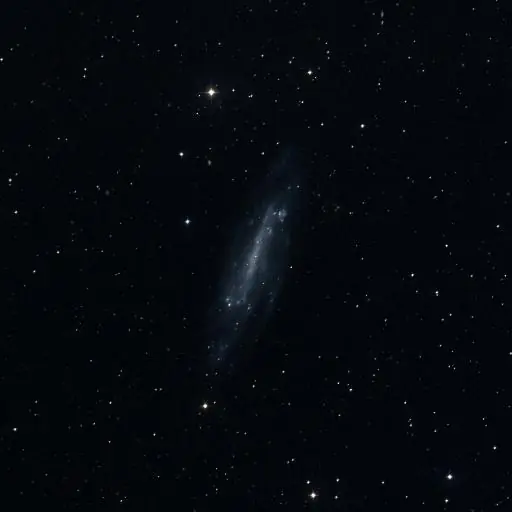
A loose, Magellanic-style spiral on the edge of the M 81 family, with three radio puzzles at its core.
Built like the Large Magellanic Cloud — a loose, barred disc with only a hint of spiral arms — NGC 4236 is the type astronomers call a Magellanic spiral galaxy.
Stars are being born right across its disc, and it is dotted with bright clouds of glowing hydrogen. Only its core is quiet, with very little star formation, while its halo stays active.
William Herschel discovered it in April 1793. Two centuries later Patrick Moore made it Caldwell 3; his list runs from north to south, so the low number marks it as one of the most northerly objects in the catalogue.
NGC 4236 (C 3) is 15 million light-years away: the light we see from it set off about 15 million years ago, when great apes were spreading through Africa and Europe.
Did you know?
- Three radio puzzles. Three radio sources sit in its quiet core. They may be the remains of supernovae — or two may be pockets of star birth and the third a Sun-like star in our own galaxy, lying in front.
- On the edge of the family. NGC 4236 belongs to the M 81 group, alongside the bright spiral M 81 and the starburst galaxy M 82, but it keeps its distance from the group’s busy centre.
How big is it?
About as wide as our Milky Way. Light itself takes 100,000 years to cross it. Shrink it to the length of a football pitch and our whole Solar System would be smaller than a bacterium.
A large, faint barred spiral in Draco seen almost edge-on; its low surface brightness makes it a dark-sky target, showing as a long, faint streak.
When and where to see it
It is best placed in the evening sky around April, when it crosses the meridian at about 10 pm local time (around midnight in March). It can be seen from everywhere north of 21°S and never sets north of 21°N.
At its highest it stands 71° up from 50°N, 56° up from 35°N, 21° up from the equator, below the horizon from 35°S.
Facts
- Type
- Galaxy
- Constellation
- Draco
- Designations
- C 3
- Magnitude
- 9.8
- Apparent size
- 24′ × 6.8′
- Position
- RA 12h 16.7m, Dec +69° 28′ (J2000)
- Distance
- 15 million light-years
- Discovered
- William Herschel, 1793
Open AstroPilot to see when NGC 4236 (C 3) is highest tonight from your location, how easy it is with your telescope or binoculars, and an eyepiece view.