NGC 4230
NGC 4230 is an open cluster in the constellation Centaurus, magnitude 9.4, 5.4′ across.
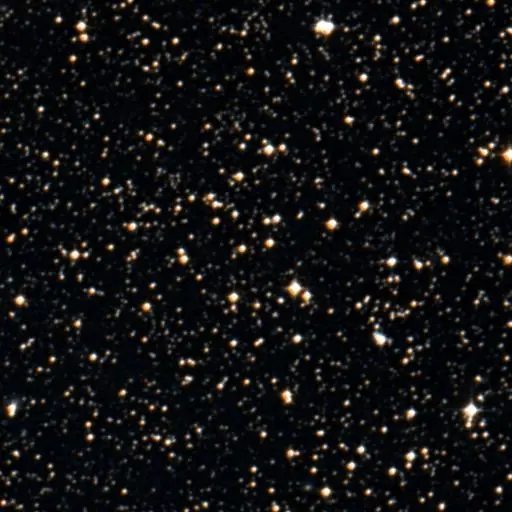
A loose cluster whose name the big databases pin on the wrong stars.
Even the big catalogues make mistakes. The ESO catalogue and the SIMBAD database both pin the name NGC 4230 on a different cluster, ESO 171-SC14. The real NGC 4230 is a loosely scattered open cluster in Centaurus, found by John Herschel on 5 April 1837 while he was observing from the Cape of Good Hope.
A 9.4-magnitude open cluster in Centaurus, about 5.4′ across.
When and where to see it
It is best placed in the evening sky around April, when it crosses the meridian at about 10 pm local time (around midnight in March). It can be seen from everywhere south of 35°N and never sets south of 35°S.
At its highest it stands below the horizon from 50°N, below the horizon from 35°N, 35° up from the equator, 70° up from 35°S.
Facts
- Type
- Open cluster
- Constellation
- Centaurus
- Designations
- NGC 4230
- Magnitude
- 9.4
- Apparent size
- 5.4′
- Position
- RA 12h 17.2m, Dec −55° 17′ (J2000)
- Discovered
- John Herschel, 1837
Open AstroPilot to see when NGC 4230 is highest tonight from your location, how easy it is with your telescope or binoculars, and an eyepiece view.