NGC 4214 (NGC 4228)
NGC 4214 (NGC 4228) is a galaxy in the constellation Canes Venatici, magnitude 9.8, 6.8′ × 5.3′ across.
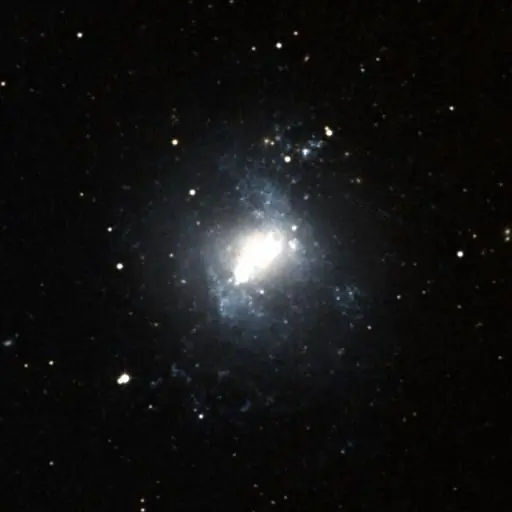
A dwarf galaxy bigger than the Small Magellanic Cloud, in the middle of a starburst.
Larger and brighter than the Small Magellanic Cloud, NGC 4214 is a dwarf galaxy in the middle of a starburst. Its two biggest star-forming regions sit at the centre: one holds a super star cluster rich in Wolf–Rayet stars, hot giants blowing off their outer layers, and the other is younger than 3 million years. Two older super star clusters, both 200 million years old, weigh about 260,000 and 1.5 million suns.
William Herschel found it on 28 April 1785.
NGC 4214 (NGC 4228) is 9.2 million light-years away: the light we see from it set off about 9.2 million years ago, when great apes were spreading through Africa and Europe.
Did you know?
- A bright supernova. In 1954 Paul Wild discovered a supernova here, SN 1954A, at magnitude 9.8 — a Type Ib, the collapse of a massive star.
- A tiny companion. One of its satellites, MADCASH-2, is an ultra-faint dwarf galaxy that, unusually, has formed stars in more than one burst: about 400 million and 1.5 billion years ago.
How big is it?
18% of the Milky Way’s width. Light itself takes 18,000 years to cross it. Shrink it to the length of a football pitch and our whole Solar System would be about the size of a red blood cell.
A 9.8-magnitude irregular galaxy (I) in Canes Venatici, about 6.8′ × 5.3′.
When and where to see it
It is best placed in the evening sky around April, when it crosses the meridian at about 10 pm local time (around midnight in March). It can be seen from everywhere north of 54°S and never sets north of 54°N.
At its highest it stands 76° up from 50°N, 89° up from 35°N, 54° up from the equator, 19° up from 35°S.
Facts
- Type
- Galaxy
- Constellation
- Canes Venatici
- Designations
- NGC 4228
- Magnitude
- 9.8
- Apparent size
- 6.8′ × 5.3′
- Position
- RA 12h 15.7m, Dec +36° 20′ (J2000)
- Distance
- 9.2 million light-years
- Discovered
- William Herschel, 1785
Open AstroPilot to see when NGC 4214 (NGC 4228) is highest tonight from your location, how easy it is with your telescope or binoculars, and an eyepiece view.