Medusa Galaxy Merger (NGC 4194)
Medusa Galaxy Merger (NGC 4194) is a galaxy in the constellation Ursa Major, magnitude 12.8, 1.6′ × 1.1′ across.
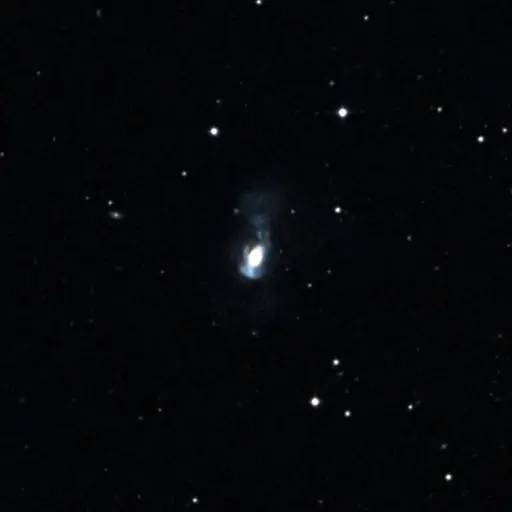
Two galaxies become one in the Medusa merger, with a furious burst of starbirth at its eye.
Two galaxies have nearly become one in NGC 4194, the Medusa merger. Loops, arcs and a tidal tail spill from its centre, and Halton Arp listed it as Arp 160 in his Atlas of Peculiar Galaxies. At its heart, the gas-rich Eye of Medusa, gas squeezed by the collision is turning into stars at a furious pace: about eight suns’ worth a year in the central region, several times the rate of the whole Milky Way.
William Herschel found it on 2 April 1791.
Medusa Galaxy Merger (NGC 4194) is 130 million light-years away: the light we see from it set off about 130 million years ago, when dinosaurs still walked the Earth.
Did you know?
- A black hole in the tail. Radio searches have found no nucleus for either of the merging galaxies. But in 2009 the Chandra X-ray Observatory picked up X-rays from a black hole out in the tidal tail.
How big is it?
62% of the Milky Way’s width. Light itself takes 62,000 years to cross it. Shrink it to the length of a football pitch and our whole Solar System would be smaller than a bacterium.
A 12.8-magnitude barred Magellanic spiral galaxy (SBm) in Ursa Major, about 1.6′ × 1.1′.
When and where to see it
It is best placed in the evening sky around April, when it crosses the meridian at about 10 pm local time (around midnight in March). It can be seen from everywhere north of 35°S and never sets north of 35°N.
At its highest it stands 85° up from 50°N, 70° up from 35°N, 35° up from the equator, 0° up from 35°S.
Facts
- Type
- Galaxy
- Constellation
- Ursa Major
- Designations
- NGC 4194
- Magnitude
- 12.8
- Apparent size
- 1.6′ × 1.1′
- Position
- RA 12h 14.2m, Dec +54° 32′ (J2000)
- Distance
- 130 million light-years
- Discovered
- William Herschel, 1791
Open AstroPilot to see when Medusa Galaxy Merger (NGC 4194) is highest tonight from your location, how easy it is with your telescope or binoculars, and an eyepiece view.