NGC 4125
NGC 4125 is a galaxy in the constellation Draco, magnitude 9.7, 5.9′ × 4.6′ across.
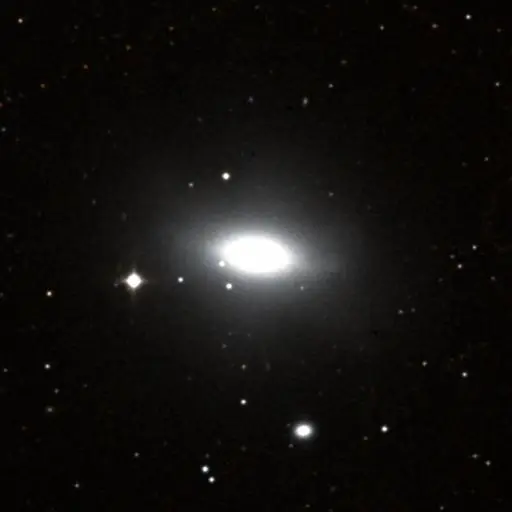
Home of 2016’s brightest supernova, in a galaxy found by an asteroid hunter.
In May 2016 a robotic telescope at Lick Observatory in California caught a white dwarf blowing up in NGC 4125. Over the next few days the supernova, SN 2016coj, brightened to magnitude 13, the brightest of the whole year. The elliptical galaxy that hosted it was found on 4 January 1850 by the English astronomer John Russell Hind.
NGC 4125 is 78 million light-years away: the light we see from it set off about 78 million years ago, when dinosaurs still walked the Earth.
Did you know?
- The discoverer’s other finds. John Russell Hind also discovered ten asteroids, among them Iris and Flora, and gave his name to Hind’s Crimson Star, R Leporis.
How big is it?
1.3 times as wide as our Milky Way. Light itself takes 130,000 years to cross it. Shrink it to the length of a football pitch and our whole Solar System would be smaller than a bacterium.
A 9.7-magnitude elliptical galaxy (E) in Draco, about 5.9′ × 4.6′.
When and where to see it
It is best placed in the evening sky around April, when it crosses the meridian at about 10 pm local time (around midnight in March). It can be seen from everywhere north of 25°S and never sets north of 25°N.
At its highest it stands 75° up from 50°N, 60° up from 35°N, 25° up from the equator, below the horizon from 35°S.
Facts
- Type
- Galaxy
- Constellation
- Draco
- Designations
- NGC 4125
- Magnitude
- 9.7
- Apparent size
- 5.9′ × 4.6′
- Position
- RA 12h 8.1m, Dec +65° 10′ (J2000)
- Distance
- 78 million light-years
- Discovered
- John Russell Hind, 1850
Open AstroPilot to see when NGC 4125 is highest tonight from your location, how easy it is with your telescope or binoculars, and an eyepiece view.