Antennae Galaxies (NGC 4039)
Antennae Galaxies (NGC 4039) is a galaxy in the constellation Corvus, magnitude 11.0 (blue), 5.4′ × 2.7′ across.
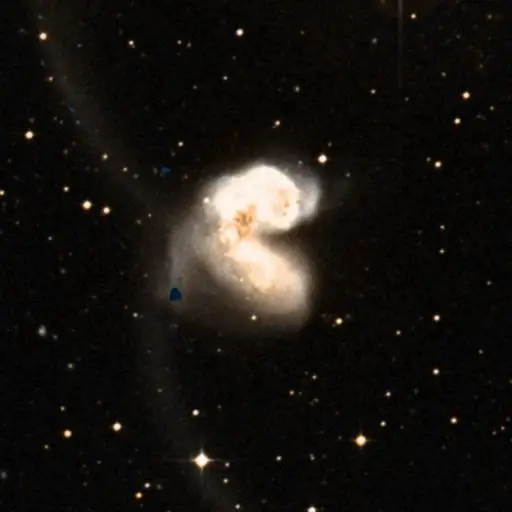
Half of the Antennae: a spiral that passed right through its neighbour, and will one day merge with it.
Six hundred million years ago, NGC 4039 and its neighbour NGC 4038 passed right through each other. Once a separate spiral galaxy, NGC 4039 has been reshaped by the encounter. Starting around 300 million years ago, stars were flung out of both galaxies, and today they stream far into space in two long, curving tails. Those tails, like an insect’s feelers, give the pair its name: the Antennae.
The story is not over. Within 400 million years the cores of the two galaxies will collide and become one. Simulations suggest the pair will end as a single giant elliptical galaxy — a fate that may one day await our Milky Way and the Andromeda Galaxy too.
Antennae Galaxies (NGC 4039) is 67 million light-years away: the light we see from it set off about 67 million years ago, when dinosaurs still walked the Earth.
Did you know?
- Hubble’s supernova. In March 1921 Edwin Hubble and John Charles Duncan discovered SN 1921A in NGC 4039 — still the only supernova recorded in this half of the pair.
- Ingredients for planets. The Chandra X-ray Observatory found clouds in the colliding pair rich in neon, magnesium and silicon, with 16 times the Sun’s share of magnesium and 24 times its silicon — elements needed to build planets.
How big is it?
About as wide as our Milky Way. Light itself takes 100,000 years to cross it. Shrink it to the length of a football pitch and our whole Solar System would be smaller than a bacterium.
The southern half of the Antennae, colliding with NGC 4038; together they make a curved, lopsided glow in medium telescopes.
When and where to see it
It is best placed in the evening sky around April, when it crosses the meridian at about 10 pm local time (around midnight in March). It can be seen from everywhere south of 71°N and never sets south of 71°S.
At its highest it stands 21° up from 50°N, 36° up from 35°N, 71° up from the equator, 74° up from 35°S.
Facts
- Type
- Galaxy
- Constellation
- Corvus
- Designations
- NGC 4039, C 61, Antennae Galaxies
- Magnitude
- 11.0 (blue)
- Apparent size
- 5.4′ × 2.7′
- Position
- RA 12h 1.9m, Dec −18° 53′ (J2000)
- Distance
- 67 million light-years
- Discovered
- William Herschel, 1785
Open AstroPilot to see when Antennae Galaxies (NGC 4039) is highest tonight from your location, how easy it is with your telescope or binoculars, and an eyepiece view.