Bow-Tie Nebula (NGC 40)
Bow-Tie Nebula (NGC 40) is a planetary nebula in the constellation Cepheus, magnitude 11.9, 48″ across.
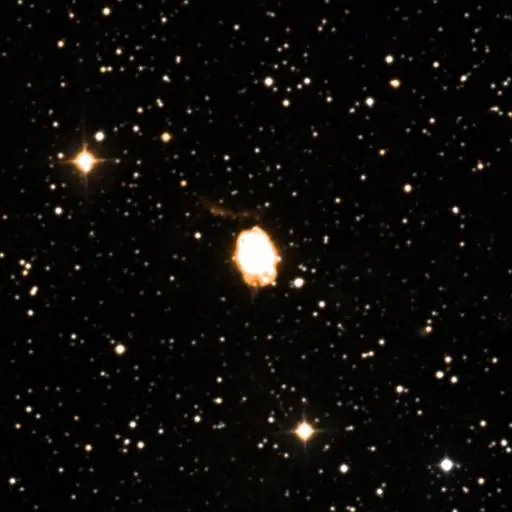
A dying star’s shed skin, heated to 10,000 degrees — and due to fade away within 30,000 years.
Around 6,500 years ago a dying star began to hollow out a cavity in the gas around it, and about 4,200 years ago it threw out lobes to the north and south. The result is NGC 40, a barrel-shaped planetary nebula with two extra pairs of lobes around its poles, the marks of further outbursts. Radiation from the star heats the gas to about 10,000 °C and makes it glow.
William Herschel discovered it on 25 November 1788. The star at its heart, HD 826, shines about 7,000 times as brightly as the Sun, yet it is only about half the Sun’s width.
Bow-Tie Nebula (NGC 40) is 5,800 light-years away: the light we see from it set off around 3780 BC, 570 years before writing was invented in Mesopotamia.
Did you know?
- A star reborn?. The central star’s surface is about 71,000 K, yet the light ionising the nebula seems to come from a source of only 45,000 K. One idea: a late thermal pulse reignited fusion and heated the star up again.
- A fleeting glow. Planetary nebulae do not last. About 30,000 years from now NGC 40 is expected to have faded away, leaving only a white dwarf about the size of Earth.
How big is it?
1,420 Solar Systems side by side. Light itself takes about a year to cross it. Shrink our Solar System — the Sun and all eight planets — to the size of a coin, and the Bow-Tie Nebula would be 34.1 m across (about the length of a tennis court); the nearest star would be a football pitch away, and the Milky Way 2,520 km across.
A planetary nebula in Cepheus around an 11th-magnitude Wolf–Rayet central star, appearing as a small oval glow with brighter edges.
When and where to see it
It is best placed in the evening sky around October, when it crosses the meridian at about 10 pm local time (around midnight in September). It can be seen from everywhere north of 17°S and never sets north of 17°N.
At its highest it stands 67° up from 50°N, 52° up from 35°N, 17° up from the equator, below the horizon from 35°S.
Facts
- Type
- Planetary nebula
- Constellation
- Cepheus
- Designations
- NGC 40, C 2
- Magnitude
- 11.9
- Apparent size
- 48″
- Position
- RA 0h 13.0m, Dec +72° 31′ (J2000)
- Distance
- 5,800 light-years
- Discovered
- William Herschel, 1788
Open AstroPilot to see when Bow-Tie Nebula (NGC 40) is highest tonight from your location, how easy it is with your telescope or binoculars, and an eyepiece view.