NGC 3953
NGC 3953 is a galaxy in the constellation Ursa Major, magnitude 10.1, 6.1′ × 3.1′ across.
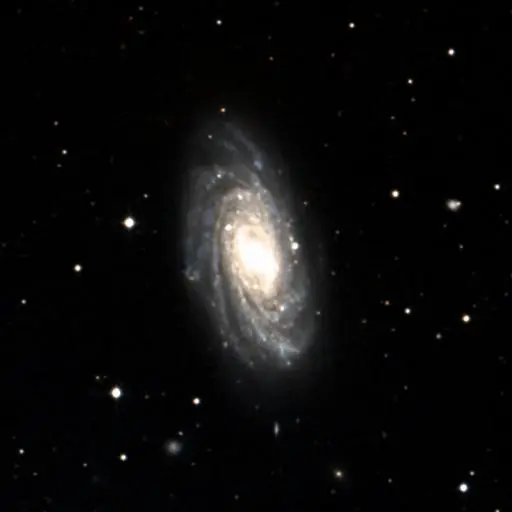
Found by Messier’s colleague Pierre Méchain — yet it never got a Messier number.
Pierre Méchain, Charles Messier’s colleague and fellow comet hunter, found NGC 3953 on 12 March 1781 — yet it never received a Messier number. It is a barred spiral galaxy with a ring of stars and gas encircling its bar. It belongs to the M 109 group in Ursa Major, a large gathering that may hold more than 50 galaxies.
NGC 3953 is 62 million light-years away: the light we see from it set off about 62 million years ago, when mammals were taking over a world without dinosaurs.
How big is it?
About as wide as our Milky Way. Light itself takes 110,000 years to cross it. Shrink it to the length of a football pitch and our whole Solar System would be smaller than a bacterium.
A 10.1-magnitude spiral galaxy (Sbc) in Ursa Major, about 6.1′ × 3.1′.
When and where to see it
It is best placed in the evening sky around April, when it crosses the meridian at about 10 pm local time (around midnight in March). It can be seen from everywhere north of 38°S and never sets north of 38°N.
At its highest it stands 88° up from 50°N, 73° up from 35°N, 38° up from the equator, 3° up from 35°S.
Facts
- Type
- Galaxy
- Constellation
- Ursa Major
- Designations
- NGC 3953
- Magnitude
- 10.1
- Apparent size
- 6.1′ × 3.1′
- Position
- RA 11h 53.8m, Dec +52° 20′ (J2000)
- Distance
- 62 million light-years
- Discovered
- Pierre Méchain, 1781
Open AstroPilot to see when NGC 3953 is highest tonight from your location, how easy it is with your telescope or binoculars, and an eyepiece view.