NGC 3938
NGC 3938 is a galaxy in the constellation Ursa Major, magnitude 10.4, 3.5′ × 3.4′ across.
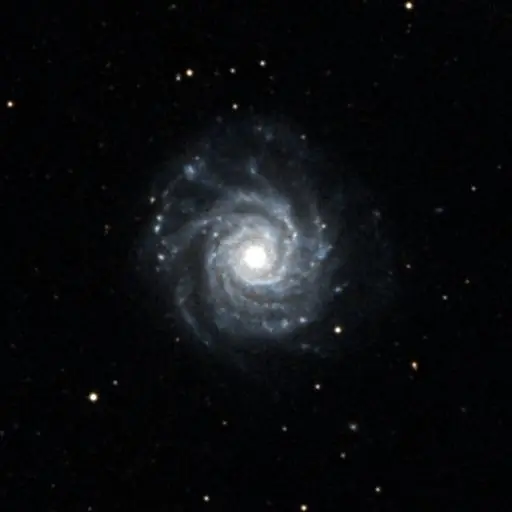
A spiral where a giant star of perhaps 50 suns or more blew up in 2017.
In May 2017 the amateur astronomer Ron Arbour spotted a new star in NGC 3938: a supernova, SN 2017ein. Older pictures of the galaxy seem to show the star before it died. If it was single, it weighed some 47 to 48 times the Sun’s mass; if it had a companion, perhaps 60 to 80. Five supernovae have now been seen in this spiral galaxy, one of the brightest in its corner of Ursa Major. William Herschel found it on 6 February 1788.
NGC 3938 is 58 million light-years away: the light we see from it set off about 58 million years ago, when mammals were taking over a world without dinosaurs.
Did you know?
- Two stars become one. In 2022 a luminous red nova, AT 2022ckk, flared here. Such outbursts are thought to mark two stars spiralling together and merging.
How big is it?
60% of the Milky Way’s width. Light itself takes 60,000 years to cross it. Shrink it to the length of a football pitch and our whole Solar System would be smaller than a bacterium.
A 10.4-magnitude spiral galaxy (Sc) in Ursa Major, about 3.6′ across.
When and where to see it
It is best placed in the evening sky around April, when it crosses the meridian at about 10 pm local time (around midnight in March). It can be seen from everywhere north of 46°S and never sets north of 46°N.
At its highest it stands 84° up from 50°N, 81° up from 35°N, 46° up from the equator, 11° up from 35°S.
Facts
- Type
- Galaxy
- Constellation
- Ursa Major
- Designations
- NGC 3938
- Magnitude
- 10.4
- Apparent size
- 3.5′ × 3.4′
- Position
- RA 11h 52.8m, Dec +44° 7′ (J2000)
- Distance
- 58 million light-years
- Discovered
- William Herschel, 1788
Open AstroPilot to see when NGC 3938 is highest tonight from your location, how easy it is with your telescope or binoculars, and an eyepiece view.